

Chapter 14 - The Translator's Price
The world has been edited. Her sibling was deleted. And she's already starting to forget why she's searching.
The port city looked different.
She'd been gone for weeks. Maybe a month. Time had gotten slippery somewhere between the lighthouse and the island, days blurring into each other until she stopped counting. But however long it had been, the city had changed in her absence.
Or maybe she had changed, and now she was seeing it clearly.
The streets felt emptier than before. Not abandoned, not deserted. Just thinner somehow, like the population had been reduced by a percentage point or two and the remaining people hadn't quite spread out to fill the gaps. Shops that should have been open were shuttered. Corners that should have had vendors were bare.
"Something's wrong here," Linn said. The girl was walking close, closer than she had a few days ago. The nervousness had been growing since they left Thornmouth.
"Something's been wrong here for a long time. We just didn't notice."
They passed the plaza with the seventeen statues for twelve founders. She counted them again out of habit. Still seventeen. The blank pedestals still gleaming in the afternoon light, names that nobody remembered carved nowhere at all.
But something else caught her attention. A group of people standing at the edge of the plaza, talking in low voices. When she passed, they went quiet. Watched her. Leaned in to whisper after she'd gone by.
That happened again at the next corner. And the one after that.
"They're looking at you," Linn said.
"I noticed."
"Do they know who you are?"
"I think so."
She'd been careful when she was here before. Hadn't asked the wrong questions in the wrong places. Hadn't told anyone what she was looking for or why. But that was before she'd spent weeks traveling, before she'd talked to the Cartographer's Daughter and Vera and Maren and god knows how many other people who'd then forgotten everything.
The Story Disease. It didn't just erase memories. It spread them first, carried them like a virus to everyone nearby, and then erased them all at once.
She'd been leaving a trail of infection everywhere she went.
"We need to find the university district," she said. "There should be scholars there. People who study old languages."
"And if they've heard of you too?"
"Then we convince them to help anyway."
They asked directions at a bread stall. The woman behind the counter looked at her for a long moment before answering, and her face had that careful blankness that meant she was trying very hard not to react.
"The university," she said slowly. "That's north. Past the temple, up the hill."
"Thank you."
"You're the one, aren't you?" The woman's voice had dropped to barely a whisper. "The one who's been asking about the disappeared?"
She didn't answer. Just took the bread she'd purchased and walked away.
Behind her, she heard the woman say to someone else, "That's her. The cursed one."
Great. She had a title now.
The university was a cluster of old stone buildings arranged around a courtyard full of dead leaves and memories of better days. Students moved between them, young people with books under their arms and futures they still believed in. A few of them stared at her as she passed. Most just went about their business.
The linguistics department was in the smallest building, tucked away in a corner like the university was embarrassed by it. Three floors of cramped offices and overflowing bookshelves and the particular smell of paper that had been sitting in one place for too long.
She asked for someone who specialized in dead languages. The clerk at the front desk gave her a long look.
"Dead languages. That's Professor Havel. Third floor, end of the hall." A pause. "But he doesn't see visitors. Hasn't for years."
"He'll see me."
"Everyone says that."
She climbed the stairs anyway.
Havel's office was behind a door that had been painted blue once and now was mostly gray. She knocked. Waited. Knocked again.
Nothing.
She tried the handle. Locked.
"He's in there," said a voice behind her.
She turned. A young man, barely older than Linn, standing in the hallway with an armload of books. Student, probably, or a junior researcher. He had the pinched look of someone who spent too much time in bad lighting.
"How do you know?"
"Because he never leaves. Been in that office for three years now, far as anyone can tell. Food gets delivered. Nobody goes in, nobody comes out." The young man shrugged. "We think he might be crazy. Or working on something he doesn't want anyone to see."
"Or both."
"Or both." The young man adjusted his books. "You're not a student."
"No."
"You're her. The one from the stories."
She felt her jaw tighten. "What stories?"
"About the woman who remembers. The woman who makes other people forget." He didn't look scared, exactly. More curious. The kind of person who studied dangerous things from what he thought was a safe distance. "Is it true? Do people really lose their memories after talking to you?"
"Some of them."
"Fascinating." He actually smiled. "I'd love to study that. The mechanism of it. The way information decay propagates through social networks. There's probably a mathematical model that could predict the spread pattern."
"People are forgetting their own names and you want to write a paper about it."
"Knowledge is knowledge." He shrugged again. "Besides, I'll probably forget I had this conversation by tomorrow. Might as well make notes while I can."
He walked away, disappearing into one of the offices down the hall. She watched him go and felt something cold settle in her stomach.
The stories had spread. Everyone knew about her now. And they were treating it like a curiosity, a phenomenon to be observed, not a plague that was eating their world piece by piece.
Maybe that was its own kind of forgetting. Easier to study the disaster than to feel it.
She turned back to Havel's door. Knocked again, harder this time.
"Go away." The voice from inside was rough, rusty from disuse. "I don't take visitors."
"I have books. Old ones. From a place that doesn't exist anymore."
Silence. Then footsteps, slow and shuffling.
The door opened a crack. An eye appeared, watery and half-blind, surrounded by wrinkles.
"What kind of books?"
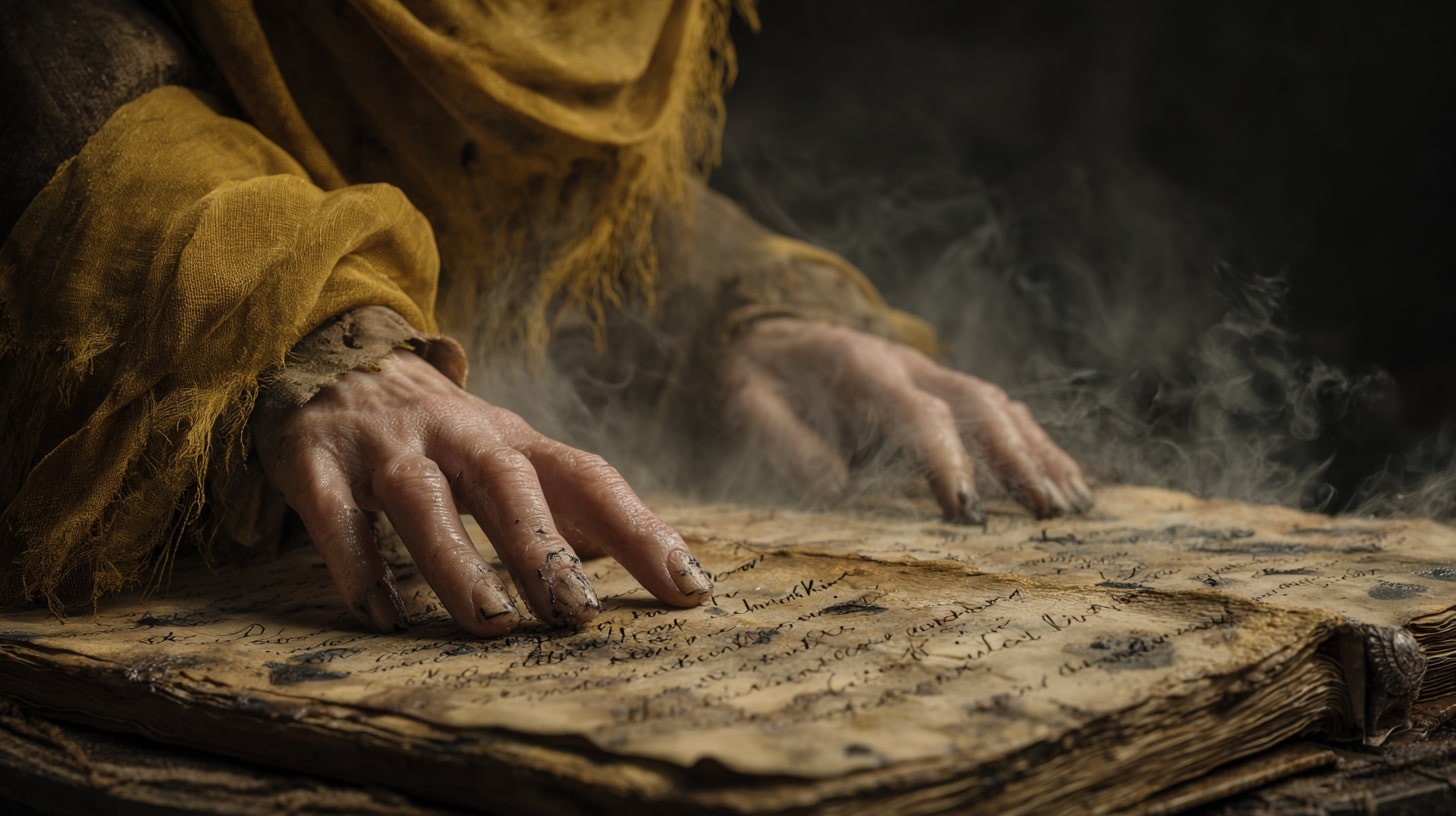
She pulled one from her pack. Showed him the cover with its strange symbols, its leather that felt wrong against her fingers.
The eye widened.
"Where did you get that?"
"An island in the stitched waters. There was an archive. I took what I could carry."
The door opened wider. Havel was old, older than she'd expected. Seventy at least, maybe eighty. Thin to the point of emaciation, his clothes hanging off him like they'd been made for someone else. But his hands, when he reached for the book, were steady.
"I haven't seen this language in forty years." His voice had changed, the roughness giving way to something that sounded almost like wonder. "I thought everyone who could read it was dead."
"Can you translate it?"
He turned the book over in his hands. Opened it carefully, reverently, and looked at the first page. His lips moved as he read.
"Yes. I can translate it." He looked up at her, and his expression was strange. Hungry and afraid at the same time. "But I won't."
"Why not?"
"Because I know what happens to people who get involved with this." He handed the book back to her, and she could see the effort it took. He wanted it. Wanted it desperately. But he was pushing it away. "My mentor translated texts like these. Thirty years ago. He was brilliant, the best linguist of his generation. And one morning he just wasn't there anymore. His office was empty. His colleagues didn't remember his name. His own wife thought she'd always been single."
"He was erased."
"He was erased." Havel's voice cracked. "I'm the only one who remembers him. The only one in the world. And I've spent the last thirty years hiding in this office, not talking to anyone, not getting involved in anything, because I know they're watching. I know they're waiting to see if I'll do something that makes me a threat too."
"Then why are you still here? Why haven't they erased you?"
"Because I'm useless. Because I sit in this room and I translate ancient poetry and I don't bother anyone." He gestured at the stacks of paper covering every surface. "I'm not a threat. I'm just a sad old man who reads dead languages for fun."
"But you could be more than that. You could help me understand what's in these books. You could help me fight back."
"And then what? I get erased and you forget you ever met me and the world goes on exactly the same as before?" He shook his head. "No. I've watched what happens to people who fight. I've seen the trail of forgetting you leave behind you. Everyone you talk to, everyone who helps you. They're all casualties."
She wanted to argue. Wanted to tell him he was wrong, that the fight mattered, that she wasn't just spreading destruction everywhere she went.
But she couldn't. Because he wasn't wrong.
"Three days," she said instead. "Give me three days. I'll stay away from you. I won't come back to this building, won't talk to anyone here, won't do anything that could connect us. Just translate what you can and leave it for me."
"Why would I do that?"
"Because you want to." She held up the book again. "Look at it. You've been waiting thirty years for something like this. Something that matters, something that proves what you've always known. Are you really going to pass that up because you're afraid?"
He stared at the book. His hands twitched at his sides.
"I could die," he said quietly. "I could be erased and nobody would ever know I existed."
"Or you could translate these texts and leave behind something that lasts longer than any of us. Something that can't be erased because it's spread too far, been read by too many people." She stepped closer. "My mentor did that. Your mentor did that. Maybe that's all any of us can do. Leave proof behind and hope someone finds it."
Havel was silent for a long time. The watery eye studied her, looking for something she couldn't name.
"Three days," he said finally. "Come back in three days. There's a bench in the courtyard, by the old oak tree. I'll leave what I've translated there, under a loose stone."
"Under a stone?"
"If they're watching me, I don't want them to know you're involved. The less direct contact, the better." He took the books from her hands, and this time he didn't hesitate. "Now go. Don't come back until the third day. Don't talk to anyone here. And for god's sake, try not to destroy anyone else's life while you're waiting."
The door closed in her face.
Three days.
It sounded simple. Find somewhere to stay, keep her head down, wait for Havel to finish his work. She'd been waiting for months already. What was another three days?
But three days in a city that knew her name and feared her touch was a different kind of waiting.
She found a room in a boarding house on the edge of town. Not the same one she'd stayed in before. That felt too dangerous, too known. This place was smaller, dirtier, run by a woman who didn't ask questions because she didn't care enough to bother.
Linn took the bed. She took the floor. Old habits now, the resignation of someone who'd stopped expecting comfort.
"What do we do now?" Linn asked.
"We wait."
"For three days?"
"For three days."
"That's a long time to do nothing."
She opened the journal. Counted the pages again, though she already knew the number. Twenty-two. Down from twenty-four when they'd left Thornmouth. Two more pages gone in the three days of travel.
At this rate, she had maybe nine or ten weeks left. Call it two months to be safe.
Two months to find the Editors. Two months to understand what the sibling had discovered. Two months to fix something that had been breaking for longer than she could imagine.
It wasn't enough. It was never going to be enough.
"We're not doing nothing," she said. "We're going to find out what stories are spreading about us. Who knows what. How bad it's gotten."
Linn sat up on the bed. "Is that smart? If people are already afraid of you..."
"Then I need to know why. I need to know what they think they know." She closed the journal and tucked it into her bag. "Besides, I'm not going to sit in this room for three days staring at the walls. I'll go crazy."
"You might already be crazy."
"Probably." She almost smiled. "But at least I'm functional crazy."
The city after dark was different from the city during the day.
The nervous watching stopped. People were too busy with their own lives, their own problems, to pay attention to strangers. The taverns filled up with workers drinking away their exhaustion. The streets emptied out except for the night workers and the lost souls who had nowhere else to be.
She moved through it like a ghost, listening more than talking, trying to piece together what had happened while she was gone.
The stories were worse than she'd expected.
At a tavern near the docks, she overheard two men discussing "the plague woman." That's what they called her. Not the searching woman, not the remembering woman. The plague woman.
"My cousin talked to her," one of them said. "Back when she first showed up. Asked her for directions or something. Seemed normal at the time."
"And now?"
"Now he can't remember his daughter's name. She's six years old and he looks at her like she's a stranger." The man took a long drink. "Doctors say there's nothing wrong with him. Say it's all in his head. But it started right after he talked to her."
"Maybe it's coincidence."
"Maybe. But how many coincidences until it's a pattern?"
She left before they could notice her. Walked the streets for hours, drifting from tavern to tavern, gathering pieces of the story that was being told about her.
The fisherman who'd given her directions to the Cartographer's Daughter. He'd forgotten his own childhood now. Couldn't remember anything before the age of twenty. His wife was taking care of him like he was an invalid.
The innkeeper who'd sold her bread. She'd closed her shop. Said she couldn't remember what she was supposed to be selling.
The pawnshop owner who'd bought her ring. He'd been found wandering the streets three days ago, unable to remember his name or where he lived. They'd taken him to the charity hospital. He was still there, still lost.
Every person she'd touched. Every conversation she'd had. Each one a casualty.
She'd known, abstractly, that this was happening. Morrow forgetting in the tavern, Vera forgetting at her farmhouse. But hearing it laid out like this, person after person, life after life, it was different. It was weight. It was evidence of a crime she hadn't meant to commit but had committed anyway.
She found a dark corner of an alley and sat there for a while, back against the cold stone, trying to breathe.
The Story Disease. It spread through her like a plague, infecting everyone she touched. And she couldn't stop. Couldn't cure it. Could only keep moving forward and hope the damage was worth the destination.
But what if it wasn't? What if she spent the last two months of her memory killing everyone she met, and then forgot why at the end anyway? What if the Editors won not because they erased her, but because she destroyed herself first?
She pulled out the journal and opened it to a blank page. Wrote in the darkness, the words barely visible.
I'm a weapon. That's what they've made me. Every person I talk to becomes a target. Every connection I make is a wound waiting to happen.
Maybe they designed it this way. Maybe the Story Disease isn't a side effect. Maybe it's the point. Make the searchers into destroyers. Make them so dangerous that no one will help them, even if they want to.
It's working.
I should stop. Should go somewhere far away and never talk to anyone again. Let myself fade in isolation, at least spare the people around me.
But I can't. The journal is dying. The sibling is dying. Everything I love is disappearing and if I stop now it's all gone forever.
So I keep going. Keep spreading the infection. Keep destroying lives because I don't know how to do anything else.
Forgive me. I don't know who I'm asking. Just... forgive me.
She went back to the boarding house as the sun was coming up. Linn was asleep, mouth open, peaceful in a way that felt fragile. The girl was already forgetting things. Small things, names and dates, the kind of details that slip away without you noticing. In a few weeks, it would be worse. In a month, she might not remember why she'd come on this journey at all.
Another casualty. Another life she was ruining by existing near it.
She should send Linn away. Should make her leave while she still remembered enough to find her way home.
But she couldn't face this alone. Couldn't bear the thought of walking into those last weeks with no one to talk to, no one to write things down, no one to remember her when she forgot herself.
Selfish. She was being selfish. Keeping Linn around because she needed the company, knowing it would kill the girl in the end.
But then, selfishness was what had gotten her this far. Selfishness and stubbornness and a refusal to accept what everyone else had accepted. That the losses were permanent. That the disappeared stayed gone. That memory was a fight you couldn't win.
She lay down on the floor and stared at the ceiling. Two more days. Then Havel would have his translation, and she'd have answers, and maybe things would start making sense.
Or Havel would be gone too, erased like everyone else who tried to help her. And she'd be back where she started, alone with a dying journal and a list of casualties that grew longer every day.
She closed her eyes and tried to sleep.
The second day was harder.
Linn woke up confused, not remembering where they were or how they'd gotten there. It took ten minutes of patient explanation to get her oriented, and even then she kept looking around the room like she expected it to change when she wasn't watching.
"The island," she said finally. "We were on an island. There was a library."
"An archive."
"Right. An archive." Her brow furrowed. "There was something in it. Something that spoke to us."
"The Guardian. The memory of the people who lived there."
"I can't remember what it looked like."
"It didn't really look like anything. It was more of a presence."
Linn nodded slowly, but her eyes were uncertain. The details were slipping away from her. Soon she'd have only fragments, and then not even that.
"We should write it down," Linn said. "Before I forget more."
"We already did. You have your notebook."
Linn looked around the room, found her pack, pulled out the battered notebook. Opened it and stared at the pages filled with her own handwriting.
"I don't remember writing this."
"You did. Yesterday. And the day before."
"It's strange." She traced a finger over the words. "Reading something you don't remember writing. Like getting a letter from a stranger who knows everything about you."
That was exactly what it was like. She'd been doing it for months now, reading journal entries she couldn't remember making, trying to piece together a life that kept slipping out of her grasp.
"Keep the notebook with you," she said. "Read it when you feel confused. It'll help anchor you."
"Does it help you? The journal?"
She thought about the blank pages. The entries that had disappeared overnight. The words she'd written and rewritten and would probably have to write again.
"Sometimes. When there's still something left to read."
They spent the day in the room. She couldn't risk going out too much, couldn't risk spreading the Disease more than she already had. So they sat and waited and tried to hold onto the things they still remembered.
She told Linn stories about the sibling. The ones she could still access, anyway. The yellow scarf, the smooth rocks, the endless questions about things that didn't make sense. Linn wrote them down, adding to the growing record of a person who was disappearing from the world.
"Why did they care so much?" Linn asked at one point. "About the inconsistencies. About the things that didn't fit."
"I don't know. I never asked."
"Never?"
"I thought it was just a phase. A game. Kid stuff that they'd grow out of." She stared at the wall, at the water stain shaped like a country that didn't exist anymore. "I was wrong. About everything."
"You're looking for them now. That has to count for something."
"Does it? I spent years ignoring what they were trying to tell me. And now I'm chasing their ghost with a dying journal and a head full of holes."
"But you're still chasing. That's more than most people do."
She didn't have an answer for that. Didn't know if persistence counted as virtue when you were leaving destruction in your wake.
Night came. The city went quiet. She lay on the floor and tried not to think about Havel, alone in his office, reading words that would probably get him killed.
One more day.
Morning of the third day.
She left Linn at the boarding house with strict instructions to stay inside and not talk to anyone. The girl was lucid today, more present than she'd been the day before. Maybe the forgetting came in waves. Maybe there were good days and bad days, the way there were with any disease.
The university courtyard was empty when she arrived. Classes hadn't started yet. The old oak tree stood in the center, its branches bare, its roots pushing up the paving stones around it.
The bench was there, just as Havel had described. Ancient wood, worn smooth by generations of students who'd sat there reading or daydreaming or falling in love.
She approached it slowly. Looked around to make sure no one was watching.
Under the bench, near the left leg, there was a loose paving stone. She'd have missed it if she hadn't been looking. She knelt down and pried it up with her fingernails.
Nothing.
Empty space. Cold dirt. No papers, no translation, no sign that Havel had ever been here.
She stared at the empty hole for a long moment. Then she stood up and looked at the linguistics building, at the window on the third floor that should have been Havel's office.
The window was dark.
She walked to the building. Climbed the stairs. Made her way down the hallway to the door that had been painted blue once and was now mostly gray.
It was open.
The office inside was empty. Not abandoned, not stripped. Just empty, the way a room was empty when the person who lived there had never existed at all. Bookshelves with no books. A desk with no papers. Walls with rectangular patches of lighter paint where pictures had once hung.
She stood in the doorway and felt something crack inside her.
Gone. He was gone. Erased while she waited, while she tried to stay away and keep him safe. It hadn't mattered. They'd known anyway. They always knew.
She was about to leave when she noticed something on the floor.
A single sheet of paper, tucked into the corner near the baseboard. She might have missed it entirely if the morning light hadn't caught the edge.
She picked it up. Unfolded it.
Havel's handwriting. Cramped and urgent, the writing of someone who knew they were running out of time.
They're coming. I can feel it. The way you can feel a storm before the rain starts.
I've finished what I could. The rest is hidden where they won't look. The bench was compromised. Find the baker on Milliner's Street. I gave her the papers. I don't know her name and she doesn't know mine. It was safer that way.
What I read... you were right. About all of it. The Editors, the cuts, the world that used to be. But there's more. More than I could translate in three days. More than maybe anyone could translate in a lifetime.
The books you found are fragments. Pieces of a larger record. Someone was trying to document everything before it got erased. They hid copies all over the world, in places the Editors couldn't find. The island archive was just one of them.
If you want to fight back, you need more. You need the other archives. You need to find the network.
But first you need to understand what they're really afraid of. It's not memory. It's not proof. It's
The writing stopped mid-sentence. There was a smear of ink, like his hand had jerked suddenly.
Then, in shakier writing, a final line.
Remember me.
She stood there in the empty office, holding the last words of a man nobody would ever remember. Tears were running down her face, but she didn't wipe them away. Let them fall. Let something, at least, be honest.
Then she folded the paper carefully, put it in her pocket next to the sibling's letter, and went to find the baker on Milliner's Street.
The baker was a woman in her fifties with flour in her hair and a suspicious look in her eyes.
"I don't know what you're talking about," she said when asked about papers. "Nobody gave me anything."
"An old man. Yesterday or the day before. He would have come in and given you something to hold."
"An old man gave me money for bread. That's all."
But her eyes flickered. Just for a second, toward the back of the shop.
"Please. He's gone now. The people who took him will come for those papers eventually. Let me take them before that happens."
"I don't know what you're talking about," the baker said again. But she stepped aside, just slightly, and her head tilted almost imperceptibly toward the back door.
She walked past her without another word. Through the back of the shop, past sacks of flour and racks of cooling bread. There was a small room at the end, more closet than office, with a desk shoved against the wall.
On the desk, under a towel that smelled of yeast, was a stack of papers.
Havel's translation.
She grabbed them and left the way she came. The baker didn't look at her as she passed. Didn't acknowledge she'd ever been there.
Smart woman. She'd probably forget this whole interaction by nightfall. Better for everyone that way.
She read the translation in the boarding house, Linn looking over her shoulder, both of them trying to understand what Havel had died for.
The papers were dense, covered in cramped handwriting and hastily drawn diagrams. He'd been working fast, trying to get as much down as possible before his time ran out.
But what he'd managed to translate changed everything.
The Editors weren't just cutting away places and people. They were cutting away possibilities. Futures that might have been. Pasts that once were. The full complexity of reality, trimmed and pruned until only a single thread remained.
The world she knew wasn't the real world. It was the edited world. A simplified version of something that had once been vast beyond imagining.
And the Editors weren't going to stop. Couldn't stop. Because the cuts were addictive, Havel wrote. Every piece they removed made the remaining world more unstable, which meant they had to cut more to compensate, which made things worse, which meant more cuts.
A spiral. A hunger that fed on itself. They'd been doing this for centuries and they would never, ever stop.
Unless someone stopped them.
The last pages of the translation were different. Less history, more instruction. Havel had found something in the texts about how to fight back.
It wasn't weapons. It wasn't magic. It was memory.
Sufficient memory, preserved and shared, could undo a cut. If enough people remembered something that had been erased, the erasure failed. The stitches came loose. The thing that had been cut away started to come back.
That was why the Editors worked so hard to erase memory along with everything else. That was why the Story Disease existed, why journals went blank, why everyone who learned the truth started forgetting.
They were afraid of being remembered.
And the journal in her bag, the fading pages with their disappearing words, wasn't just a record. It was a weapon. One that the Editors were working overtime to destroy.
She looked at Havel's translation, at the pages he'd given his life for, and felt something shift inside her.
All this time she'd been thinking of the journal as a casualty. Something she was losing, something she was grieving.
But it wasn't dying. It was being attacked. Actively, deliberately, because it was dangerous.
Because she was dangerous.
"They're afraid of you," Linn said quietly. She'd been reading along, her lips moving slightly as she worked through Havel's cramped handwriting. "That's what all of this means, isn't it? They're afraid of what you remember."
"They're afraid of what I might remember. Of what I might make other people remember." She touched the journal through her bag, feeling its weight. "The sibling figured this out. That's why they went to confront the Editors. They thought they could use the journal somehow, use the proof, to force them to stop."
"But they got erased instead."
"They went alone." She pulled out the sibling's letter, read the familiar words one more time. "Don't follow the Backwards River alone. That's what they wrote. They knew it was a mistake, and they did it anyway, and it got them erased."
"So what do we do?"
She looked at Linn. At the girl's tired face and worried eyes and the notebook clutched in her hands like a lifeline.
"We find the other archives. The network Havel mentioned. If there are more records, more proof, maybe we can build something they can't erase."
"And the Backwards River?"
"Eventually. But not alone. The sibling was right about that." She folded the translation, added it to her pack with everything else. The weight was growing, physical and otherwise. "First we get stronger. Then we fight."
Linn nodded slowly. But there was doubt in her eyes. The same doubt that had been growing in her own chest since they'd left the island.
They were running out of time. The journal was failing. Linn was forgetting. Every day that passed was another day closer to the end.
But Havel had been erased for giving her three days of answers. The Cartographer's Daughter had burned her life's work. The sibling had disappeared into a river that flowed the wrong direction.
Everyone who took shortcuts ended up gone.
Maybe the long way was the only way that worked.
She gathered her things and stood.
"Let's go. We've been in this city too long already."
"Where are we going?"
She looked north, toward the mountains she couldn't see from here but knew were waiting.
"I don't know yet. But not here. Somewhere the stories haven't spread."
If such a place still existed.
If anywhere was safe anymore.
She walked out of the boarding house and into the morning light, carrying the weight of dead men's words and the fading memory of someone she'd never stop trying to find.
The city watched her go.
And somewhere, in the spaces between things, the Editors watched too.
Table of Contents
Get World Updates
Be notified when new stories or content are added to this world.