
Chapter 13 - What Was Cut Away
The world has been edited. Her sibling was deleted. And she's already starting to forget why she's searching.
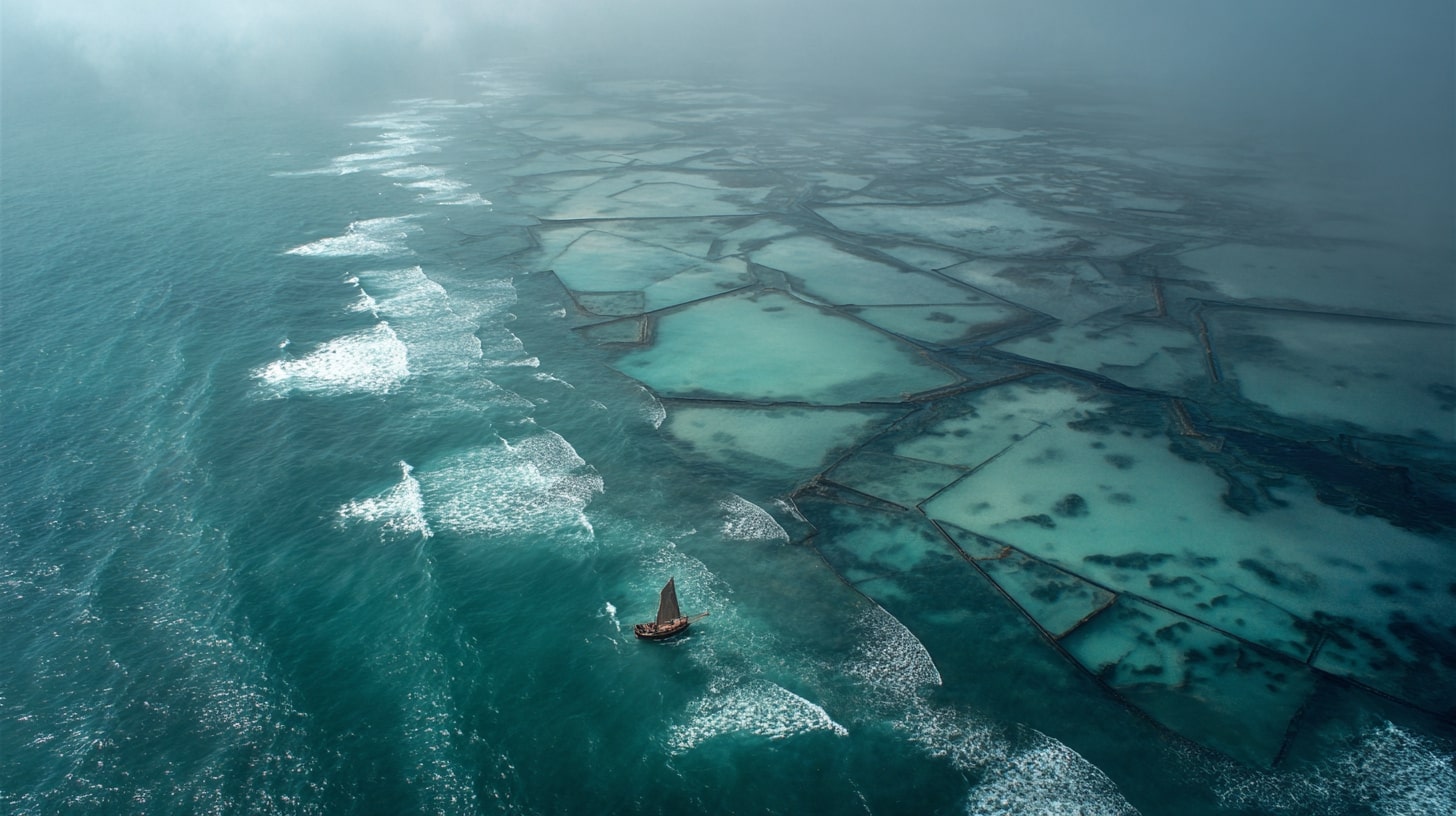
The journey back through the stitched waters was worse than the journey in.
Maren said it was because they'd taken things from the island. The water knew. The seams knew. Whatever force held this broken ocean together could feel that pieces of the forgotten place were leaving, and it didn't want to let them go.
She didn't know if that was true. But the currents fought them at every turn, the temperature lines cut sharper than before, and twice the boat was nearly capsized by waves that came from nowhere and disappeared just as fast.
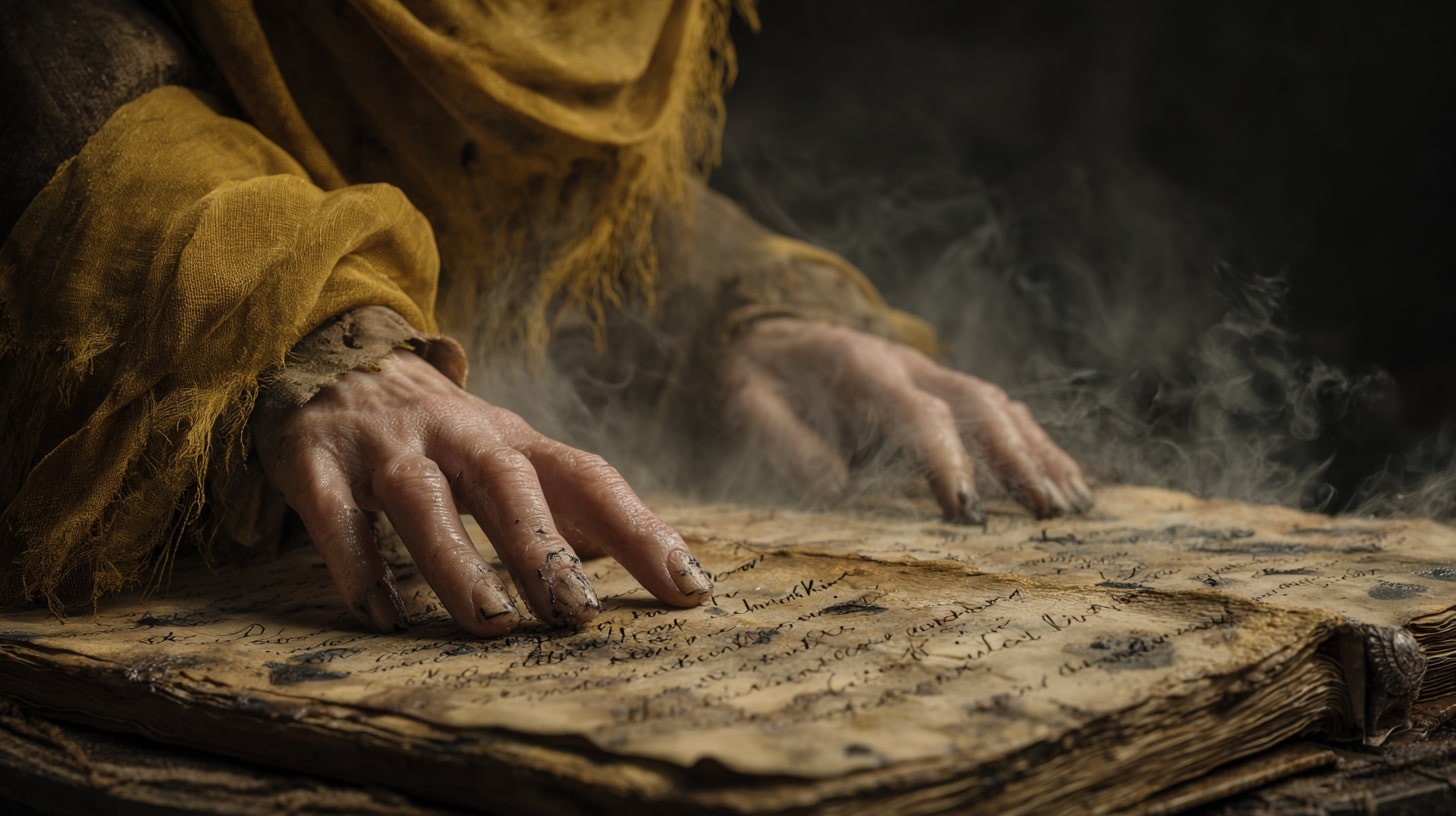
She spent most of the crossing below deck, hunched over the books she'd taken from the archive. The language was incomprehensible, symbols and characters that didn't correspond to anything she'd ever seen. But the illustrations told a story, and she was starting to understand it.
The first book showed the Editors at work.
They weren't human. Or they had been once, maybe, but they weren't anymore. The illustrations depicted figures in robes, faces hidden, hands holding those terrible shears. They moved through the world like surgeons, examining reality, deciding what belonged and what didn't. And when they found something that didn't fit their vision, they cut it out.
The process was methodical. First they would sever the connections, the relationships between the thing being erased and everything around it. Then they would cut the thing itself, removing it from the fabric of existence. Finally they would stitch the wound closed, pulling reality together so smoothly that no one would remember there had ever been a gap.
Except for the seams. The seams always remained, faint scars where the stitching showed.
"Why?" Linn asked, looking over her shoulder at the illustrations. "Why would anyone do this?"
"I don't know yet." She turned pages, looking for answers. "The pictures show what they do, not why they do it."
The second book was different. Less instructional, more historical. It showed the world as it had been before the cuts began. Vast continents she didn't recognize, connected by bridges of land that didn't exist anymore. Civilizations that had built things she couldn't comprehend, structures that defied the laws of physics she understood.
And it showed the moment when the cutting started.
A single illustration, larger than the others, taking up an entire page. A figure standing at the center of reality, shears raised, making the first cut. Around the figure, the world was already starting to fray, threads of existence coming loose, pieces beginning to separate.
Below the illustration, text she couldn't read. But the meaning was clear enough from context.
This was the beginning. Someone had looked at the world and decided it needed to be smaller.
"The sibling saw all of this," she said quietly. "They sat at that table and looked at these same pictures and understood what was happening."
"And then they went to find the Editors."
"And then they were erased."
She closed the book and stared at the cabin wall. The boat rocked beneath her, fighting its way through hostile water. Every mile they traveled was a mile further from the island, a mile closer to wherever the Editors were hiding.
The letter was in her pocket. She'd read it a dozen times already, memorizing the words even though she couldn't remember the handwriting that had written them.
I know what they're doing now. I know why they're cutting pieces out of the world and I know what they're afraid of.
What were they afraid of? What could possibly frighten beings powerful enough to cut reality itself?
She pulled out the third book, the one with the most yellow fabric markers. The sibling had spent the most time with this one, had marked more pages than any of the others. Whatever answers they'd found, this was where they'd found them.
The illustrations here were different. Less clinical, more desperate. Figures running, hiding, trying to escape the shears. Whole cities disappearing in a single cut. People reaching for each other as they dissolved into nothing.
And then, near the middle of the book, something that made her stop.
A figure standing against the Editors. Not running, not hiding. Fighting back. Holding something in their hands, some kind of object or weapon, using it to block the shears.
The Editors were recoiling. Afraid.
"They can be stopped," she breathed. "There's something that can stop them."
Linn leaned closer. "What is that thing? The object the person is holding?"
She studied the illustration. The object was drawn simply, a rectangle with lines on it. It could have been anything. A book, a tablet, a piece of paper.
Or a journal.
Her hand went to her bag, to the weight of her own journal inside it. Fading pages, dissolving memories, the last proof that someone she loved had ever existed.
Could that be what the Editors were afraid of? Records? Evidence? Proof that the things they'd cut away had been real?
She turned more pages, looking for confirmation. The illustrations showed more battles, more confrontations. In each one, the figures fighting back were holding something. Documents, books, objects that looked like they contained information.
And in each one, the Editors were losing.
"They're afraid of being remembered," she said slowly, working it out as she spoke. "That's why they erase things so completely. Not just the places and the people, but the memories too. Because if anyone remembers, if anyone has proof, their cuts don't hold."
"But people do remember. You remember. The Cartographer's Daughter remembered. Maren's grandmother remembered."
"Fragments. Pieces. Not enough to threaten them." She looked at the books spread around her, the accumulated knowledge of a civilization that had been wiped from existence. "But this is different. This is complete. This is everything they knew, everything they were. If someone could read this, could translate it, could share it with the world..."
"The cuts would come undone."
"Maybe. Or maybe the Editors would just erase whoever tried." She thought about the sibling, walking toward the Editors with whatever knowledge they'd gained from these books. "That's what happened, isn't it? They learned too much. They became a threat. So they got cut away like everything else."
Linn was quiet for a moment. Then she said, "But you have the books now. You have the letter. You know what they knew."
"Which means I'm a threat too."
"Which means they'll come for you."
She looked at the girl. Young and scared and in way over her head. Just like the sibling had been, once. Just like she herself was now.
"They've been coming for me since I started asking questions. The forgetting, the memory loss, the journal going blank. That's them, trying to erase me the same way they erased everyone else."
"But you're still here."
"For now." She gathered the books, stacked them carefully, wrapped them in cloth to protect them from the salt air. "I don't know how much longer I have. The journal's almost empty. My memories are going faster than ever. At some point I won't remember why I'm fighting, and then it'll be over."
"Then we need to find someone who can read these. Fast."
"I know." She tucked the wrapped books into her pack, feeling their weight. "The Cartographer's Daughter might have known someone. Or there might be records in the port city, scholars who study old languages. We'll figure it out."
The boat lurched suddenly, throwing her against the wall. She heard Maren cursing above deck, heard the wind pick up, heard the water slapping against the hull with renewed violence.
They were nearing the edge of the stitched waters. One more push and they'd be through.
She climbed up to the deck. The sky was gray and angry, clouds piling up on the horizon like they were building toward something. Maren was at the tiller, fighting to keep the boat on course, her scarred hands white-knuckled on the wood.
"We're almost out," the old woman shouted over the wind. "One more seam and we're clear."
She could see it ahead. The line where the confused water ended and the normal ocean began. Just a few hundred yards. Just a little further.
The boat crossed the seam with a shudder that ran through the whole vessel. For a moment everything went sideways, the deck tilting at an impossible angle, the sky and the sea trading places.
Then they were through. The water flattened out, the wind steadied, the world remembered how to work.
Maren sagged against the tiller. "That was worse than any crossing I've ever made. Whatever you took from that island, it didn't want to leave."
"I know." She looked back at the stitched waters, at the confused patch of ocean they'd just escaped. "But I need what's in these books. It's the only way to understand what happened."
"And then what? You understand, and then what?"
"Then I find the Editors. And I make them bring back what they took."
Maren laughed, harsh and humorless. "You're going to fight beings that can cut pieces out of reality. With what? Some old books and a journal that's falling apart?"
"With whatever I have." She met the old woman's eyes. "Your husband was taken by something in those waters. Don't you want to know what? Don't you want to understand?"
"Understanding won't bring him back."
"Maybe not. But maybe it will." She gestured at the books in her pack. "These show that the Editors can be fought. That people have stood against them and won. That the cuts can be undone."
"Maybe. Or maybe those are just old stories from a place that doesn't exist anymore."
"Maybe." She turned away, looked toward the coast, still hours away but visible now on the horizon. "But I have to believe there's a chance. Otherwise, what's the point of any of this?"
Maren didn't answer. Just turned back to the tiller and kept steering them home.
They reached Thornmouth at sunset.
The village looked the same as when they'd left. Weathered buildings, boats on the beach, people going about their lives without any idea that an impossible island existed a day's sail from their homes. Normal. Ordinary. Safe in their ignorance.
She envied them.
Maren tied up the boat and accepted her payment without comment. No thank you, no farewell, just the coins changing hands and the old woman turning away.
"You ever want to go back out there," Maren said over her shoulder, "find another captain. I'm done with the stitched waters."
"I understand."
"No. You don't." Maren looked back at her, and there was something in her eyes that hadn't been there before. Fear, maybe. Or respect. "Whatever you woke up on that island, whatever followed us back, I could feel it the whole way. Something watching. Something waiting. You've got its attention now, and that's not something you can outrun."
She thought about the Guardian in the archive doorway. The voice in her head, asking to be remembered. Had it followed them? Was it still there, somewhere, watching from a distance?
"I'm not trying to outrun anything," she said. "I'm trying to catch up."
Maren shook her head and walked away, disappearing into the village, back to whatever life she had when she wasn't sailing into impossible waters.
She watched her go and felt something like kinship. Two women searching for people the world had forgotten. One who'd given up and one who couldn't.
"What now?" Linn asked.
"Now we find someone who can read these books." She shouldered her pack, feeling the weight of the stolen knowledge. "The Cartographer's Daughter mentioned scholars. People who studied old languages, old maps, old ways of understanding the world. There might be some in the port city."
"That's three days' travel."
"Then we'd better start walking."
They left Thornmouth as the last light faded from the sky. The road stretched out ahead of them, dark and empty, leading back toward the world they knew.
But the world they knew wasn't the whole world. She understood that now. The world they knew was just what was left after the Editors had finished cutting. A fraction of what used to be, stitched together so carefully that no one remembered what was missing.
Almost no one.
She pulled out the journal as they walked and opened it by moonlight. The pages were harder to see in the darkness, but she could feel them. The ones that still had writing and the ones that had gone blank.
Twenty-four pages left. Down from thirty-one just a few days ago.
She'd lost seven pages crossing the stitched waters. Seven pages of memories, of notes, of the fragile record she'd been keeping since this all began.
At this rate, she had maybe three months. Maybe less.
She closed the journal and kept walking.
Three months to find someone who could read the books. Three months to learn what the sibling had learned. Three months to find the Editors and make them answer for what they'd done.
It wasn't enough time. It was never going to be enough time.
But it was what she had.
And she wasn't going to waste it.
They made camp that night in a hollow off the road, sheltered from the wind by a stand of trees. Linn built a fire while she spread out the books, trying to make sense of what she'd taken.
The illustrations told a story, but an incomplete one. She could see the what but not the why. The Editors cut pieces out of the world, that was clear. They'd been doing it for a long time, that was also clear. But she still didn't understand what drove them. What they were trying to achieve.
She found a section in the third book that seemed relevant. More illustrations, but these were different. They showed the world not as it had been, but as it might be. A vision of the future, maybe, or a plan.
In the Editors' vision, the world was small. Simple. Comprehensible. All the strange and wonderful things that had existed, the impossible bridges and the forgotten civilizations and the knowledge that defied understanding, all of it was gone. What remained was ordinary. Safe. Controlled.
"They're afraid of complexity," she said, working it out. "They're cutting away everything that doesn't fit their vision of what the world should be."
Linn looked up from the fire. "But why? What's wrong with complexity?"
"I don't know. Maybe they think it's dangerous. Maybe they think people can't handle it." She turned another page and found an illustration that chilled her. "Or maybe they just want control. A simple world is easier to manage than a complex one."
The illustration showed the Editors not as robed figures but as they really were. Or how this artist had imagined them, anyway. Not human. Not even close. Beings of pure intention, without bodies, without faces. Just will and shears, cutting and cutting, shaping reality into something that fit their design.
"They're not people," she said. "They're something else. Something that looks at the world and sees only what should be removed."
"Can something like that even be fought?"
"The book says yes. The illustrations show people fighting back, holding them off with records and evidence." She looked at her own journal, sitting beside the fire. "With proof."
"But your proof is disappearing."
"I know." She touched the leather cover, felt the warmth of it. "That's why I need these books translated. That's why I need to understand what the sibling learned. My memories aren't enough. They're fading too fast. But if I can find external proof, records that don't depend on my memory, maybe I can hold on long enough to do something."
Linn was quiet for a moment. Then she pulled out her own notebook, the one she'd been keeping as a backup of the protagonist's memories.
"I've been writing everything down," she said. "Everything you've told me, everything I've seen. If your journal goes blank, I'll still have this."
"You're already starting to forget. I've seen it. The Story Disease is spreading to you too."
"Maybe. But I forget slower than you. And I'm writing faster than I forget." Linn held up the notebook, showed the pages covered in cramped handwriting. "This is proof too. This is another copy. Even if we both forget, maybe someone will find this and remember for us."
She looked at the girl across the fire. Young and stubborn and probably doomed. But also brave. Braver than she'd given her credit for.
"Thank you," she said. "For all of this. For coming with me. For believing me when nobody else would."
"My grandmother believed you before she ever met you. That's good enough for me."
They sat in silence for a while, watching the fire burn down. The books lay spread around them, full of knowledge they couldn't read, answers they couldn't access yet.
But tomorrow they'd keep moving. Tomorrow they'd get closer to someone who could help.
And if they were lucky, if the journal held out and the memories didn't fade too fast, maybe they'd find what they were looking for before it was too late.
She picked up the letter again, the one the sibling had left in the archive. Read it one more time by firelight.
Don't give up. Please. Whatever happens, don't give up.
"I won't," she whispered. "I promise."
She folded the letter carefully and put it back in her pocket. Closed the books and wrapped them and stowed them in her pack.
Then she lay down near the fire and closed her eyes.
Tomorrow was another day. Another step toward the truth.
She just had to make sure she remembered why she was taking it.
Table of Contents
Get World Updates
Be notified when new stories or content are added to this world.