
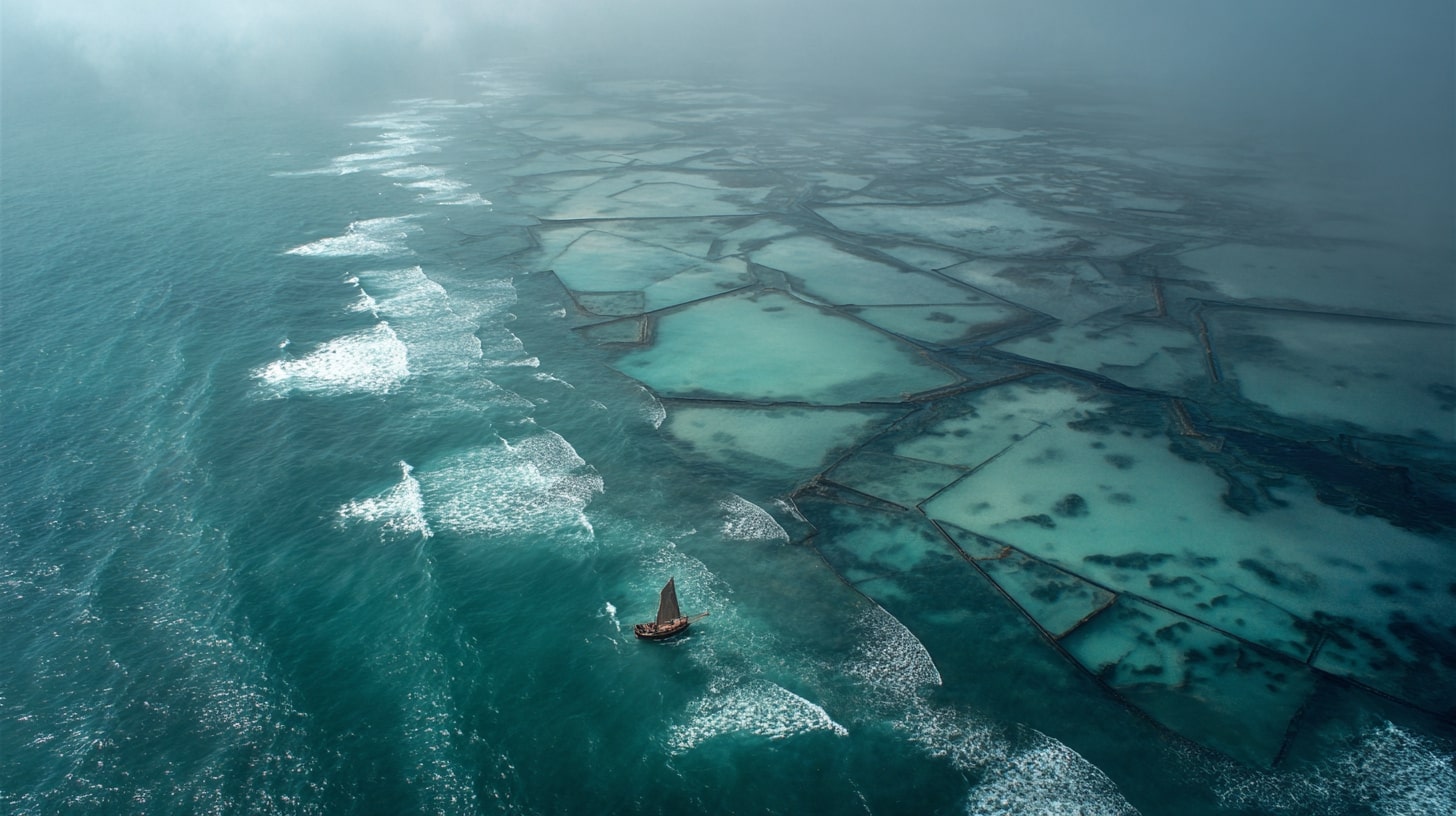
Chapter 12 - The Island That Shouldn't Be
The world has been edited. Her sibling was deleted. And she's already starting to forget why she's searching.
She woke to Maren shaking her shoulder.
"You need to see this."
The sky was gray with early dawn, the sun not yet visible above the horizon. The boat rocked gently in water that had gone still overnight, the confused currents settling into something that almost felt normal.
She stood up, joints aching from sleeping on the deck, and looked where Maren was pointing.
The island was there.
It shouldn't have been. She'd studied enough maps over the past months to know that nothing was supposed to exist at these coordinates. Open water, that's what every chart said. Miles of empty ocean in every direction.
But the island was there anyway. Rising from the sea like it had been waiting for them, green and gray and impossible.
"That's not on any map," Maren said. Her voice was strange. Hushed, almost reverent. "I've sailed these waters for forty years. I've never seen that."
"It's on the old maps. The ones from before the cuts."
"Before the cuts." Maren repeated the words like she was testing them. "You really believe that, don't you? That someone's been cutting pieces out of the world?"
"I don't believe it. I know it." She grabbed her pack and started checking her supplies. Journal, compass, the map of seams. Everything she needed. "Can you get us to shore?"
"I can try. But I'm not setting foot on that thing."
"I'm not asking you to."
Maren guided the boat closer. The water here was different from the stitched sea they'd crossed yesterday. Calmer, clearer. She could see all the way to the bottom, twenty feet down, the sandy floor dotted with rocks and what might have been the ruins of old structures.
"There used to be more," she said, mostly to herself. "This was part of something bigger."
"How do you know?"
"Look at the shape of the coastline. The way it curves and then just stops." She pointed at the island's eastern edge, where cliffs dropped straight into the water like someone had sliced through them with a knife. "That's not erosion. That's a cut. Whatever used to be connected to this place, it's gone now."
Maren didn't answer. Just kept steering, her face unreadable.
They found a beach on the island's western side. Small, rocky, but enough to pull a rowboat onto. Maren dropped anchor fifty yards offshore and helped them lower the smaller boat.
"I'll wait here until sunset," she said. "If you're not back by then, I'm leaving."
"Fair enough."
"I mean it. I've lost enough to these waters. I'm not losing my ship too."
She climbed into the rowboat. Linn followed, pale but determined. They rowed toward the shore in silence, the only sound the splash of oars and the cry of birds she didn't recognize.
The beach was made of white stones, smooth and round, polished by water that had been working on them for longer than she could imagine. She jumped out and pulled the boat up onto the shore, her boots crunching on the rocks.
The island stretched out ahead of them. Trees she didn't recognize, leaves in colors that weren't quite green. A path leading inland, overgrown but still visible. And beyond the trees, the shapes of buildings.
"Someone lived here," Linn said.
"A lot of people lived here. Before."
They started walking.
The path led through the forest and into what had once been a town.
She'd expected ruins. Crumbling walls, collapsed roofs, the slow decay of abandonment. That's what happened to places when people left. Time ate them, wore them down, turned them back into the earth they'd been built from.
This wasn't that.
The buildings were intact. Stone and wood and something else, a material that looked like glass but felt like metal when she touched it. Windows unbroken, doors still on their hinges, streets clear of debris. Everything preserved, everything whole.
But empty. Completely, utterly empty.
"It's like everyone just vanished," Linn whispered. "Like they were here one second and gone the next."
"That's exactly what happened."
She walked down what must have been a main street. Shops on either side, their windows displaying goods that had been waiting for customers for who knew how long. Clothing that should have rotted, food that should have spoiled, books with pages that should have yellowed and crumbled. All of it perfect, all of it untouched.
The architecture was wrong. Not badly designed, not ugly. Just wrong, in a way she couldn't quite articulate. The proportions were off, the angles slightly different from what she was used to. Like someone had built a city based on a description of cities without ever having seen one.
Or like the people who'd built this place had different ideas about how buildings should look.
"This isn't from our world," she said. "Or it is, but from a version of the world that doesn't exist anymore."
"What do you mean?"
"The Cartographer's Daughter said that the cuts weren't just removing places. They were removing knowledge, culture, ways of being. The people who lived here, they didn't just disappear. Everything they knew, everything they built, everything they believed—all of it got erased too."
She stopped in front of a building that might have been a temple or a government hall. Tall columns, a wide staircase, symbols carved into the stone that didn't match any language she'd ever seen.
On the wall, at the bottom of the stairs, someone had scratched letters into the stone.
Her heart stopped.
The letters were rough, hurried, obviously done with a knife or a sharp rock. Not the elegant carvings that covered the rest of the building. These were human. Recent.
She moved closer and read them.
Two letters. Just two. Carved deep enough that they'd last.
Initials.
She couldn't remember whose initials they were. That knowledge had been erased along with everything else. But she knew, with absolute certainty, that the person who'd carved them was the person she was looking for.
"They were here." Her voice came out choked. "They actually came here."
Linn was beside her, looking at the initials. "You recognize them?"
"I can't remember the name. But I know these are right. I know this is them." She touched the carved letters with her fingertips, feeling the rough edges where the stone had been scraped away. "They stood right here. They held a knife and carved their initials and they were real. They existed."
The grief hit her out of nowhere. Not for the sibling she couldn't remember, but for herself. For all the months she'd spent searching, wondering if she was chasing a delusion, wondering if the person she loved had ever been real at all.
And here was proof. Scratched into ancient stone by hands she couldn't picture anymore.
They had been real. They had come to this impossible island. They had left a mark.
"There's more," Linn said gently. "Look."
Below the initials, more words had been carved. Smaller, harder to read, like they'd been added in a hurry.
ARCHIVE. CENTER OF TOWN. ANSWERS.
Archive. Answers.
"They found something." She straightened up, wiping her eyes with the back of her hand. "They came here looking for answers and they found an archive. Center of town."
"Then that's where we go."
They kept walking.
The town was larger than it had looked from the shore. Street after street of perfectly preserved buildings, each one different, each one wrong in its own way. They passed houses with too many windows and shops with too few doors and a fountain in a square that still had water flowing even though there was no pump, no source, nothing that should have kept it running.
The center of town was obvious when they reached it. A large open plaza, bigger than anything she'd seen in any city she'd visited. The buildings around it were taller, grander, covered in more of those indecipherable symbols.
And in the middle of the plaza, a structure that could only be the archive.
It was built like a ziggurat, stepped layers rising toward the sky, each level smaller than the one below. The walls were covered in carvings, thousands of them, symbols and images and what might have been text. Windows at every level, dark and empty.
The door at the base stood open.
"They went in there," Linn said. "That's where they found whatever they found."
She approached the archive slowly. The feeling of being watched was stronger here, a prickle at the back of her neck that wouldn't go away. Something knew they were on this island. Something was paying attention.
But she couldn't stop now. Not when she was this close.
The interior of the archive was dark. She waited for her eyes to adjust, shapes slowly emerging from the shadows. Shelves, she realized. Rows upon rows of shelves, stretching back into darkness, filled with objects she couldn't identify.
"Do you have a light?"
Linn pulled a small lantern from her pack, struck a spark, and the flame caught. The light pushed back the darkness and revealed what surrounded them.
Books. Thousands of them. Tens of thousands. Shelves rising from floor to ceiling, so many that she couldn't see the walls. But not just books—scrolls, tablets, bundles of what might have been paper or might have been something else entirely. An entire civilization's worth of knowledge, preserved and waiting.
"God," Linn breathed. "This is everything. This is everything they knew."
She walked deeper into the archive. The shelves seemed to go on forever, categories she couldn't read, organization she couldn't understand. How was she supposed to find anything in here? How had the sibling found anything?
Then she saw it.
A table near the back, covered with books and papers, a chair pushed back like someone had just stood up. On the table, a candle that had burned down to nothing, wax pooled and hardened.
Someone had been working here. Recently enough that the candle had still been burning when they left.
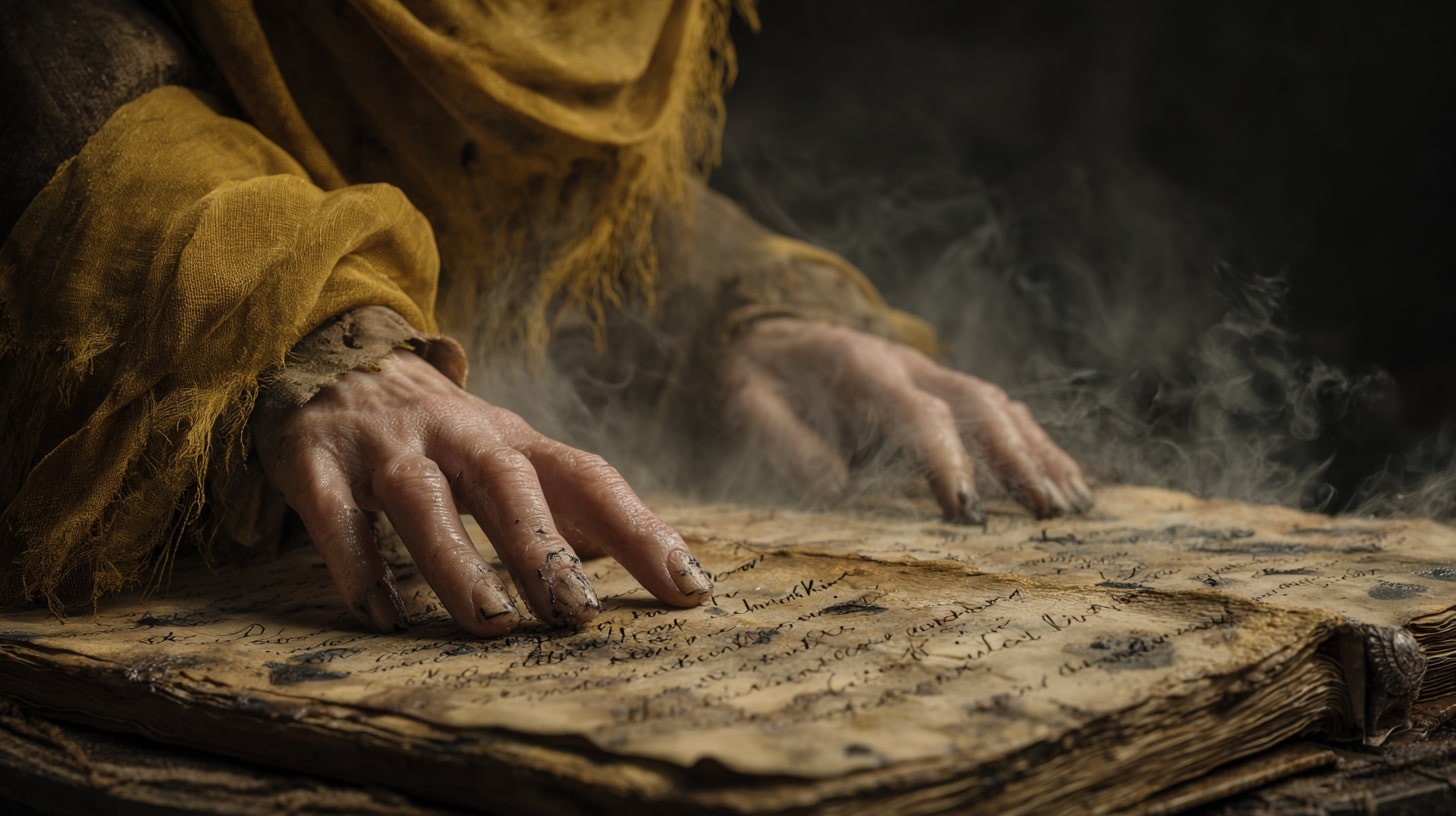
She approached the table. The books spread across it were open to various pages, some marked with scraps of fabric. Yellow fabric. Torn from a scarf.
"They marked their place." Her voice was barely a whisper. "They were reading these books and marking where they stopped."
She looked at the pages. The text was in a language she couldn't read, symbols and characters that meant nothing to her. But there were images too. Diagrams, illustrations, maps.
One of the books was open to a page that showed a figure cutting something with a pair of shears. Not scissors, not a knife. Shears, like the kind you'd use to cut cloth. And the thing being cut wasn't fabric. It was the world. The figure was cutting pieces out of reality itself.
"The Editors," she said. "This is about the Editors."
"Can you read it?"
"No. But I can see what it's showing." She turned pages, found more illustrations. Figures with shears, cutting out islands, cities, people. Other figures stitching things back together, sewing the world into a new shape. "They documented the process. How the erasures work. What happens when something gets cut out."
She kept turning pages. More diagrams, more illustrations. A sequence that showed an island being removed, the ocean rushing in to fill the gap, the seams appearing where reality had been stitched back together.
And then, near the end of the book, a map.
Not like the maps she'd seen before. This one showed the world from above, the whole planet laid out like someone had peeled it flat. And it was covered in marks. Cuts. Hundreds of them, thousands, scattered across every continent and every ocean. Places that had been removed, erased, sewn over.
The world wasn't just missing pieces. It was mostly pieces.
"How much is gone?" Linn was looking over her shoulder at the map. "How much of the world has been cut away?"
"I don't know. A lot. More than I imagined."
She stared at the map and felt something shift inside her. She'd known the erasures were real, had seen the evidence with her own eyes. But this was different. This was scale. This was a systematic campaign of removal that had been going on for longer than she could comprehend.
The sibling had seen this. Had stood at this table and looked at this map and understood the scope of what they were fighting against.
No wonder they'd been erased. You couldn't let someone walk around with knowledge like this. You couldn't let them tell people that the world was a fraction of what it used to be.
"We need to take this." She started gathering the books, the ones with the yellow fabric markers. "Whatever they found, whatever they were reading, we need to take it with us."
"How? There's too much."
"Not all of it. Just the ones they marked. The ones that mattered."
She worked quickly, pulling books from the table, checking for the yellow fabric scraps. Five books, six. Each one heavy, awkward to carry. But she'd manage. She had to.
Then she found the paper.
Tucked into one of the books, folded small, a piece of paper that was different from the rest. Newer. Rougher. The kind of paper that came from their world, not this one.
She unfolded it with trembling hands.
A letter. Written in handwriting she couldn't recognize anymore but knew was right.
If you're reading this, you found my trail. Good. That means I was right about you.
I know what they're doing now. The Editors. I know why they're cutting pieces out of the world and I know what they're afraid of. The answers are in these books if you can find someone to translate them.
I'm going to confront them. I found out where they are. I'm going to make them stop, or at least make them answer for what they've done.
If I don't come back, don't follow me. Find another way. There has to be another way.
I'm sorry I didn't tell you what I was doing. I'm sorry I left without saying goodbye. But if I'd told you, you would have tried to stop me, and I couldn't let you do that.
You were always trying to protect me. Now it's my turn.
I love you. I've always loved you. Even if you can't remember that, I hope you can feel it.
Don't give up. Please. Whatever happens, don't give up.
She couldn't read anymore. The words blurred, her vision going watery, the letter shaking in her hands.
They'd known. They'd known they might not come back. They'd left this letter hoping someone would find it, hoping she would find it, and then they'd walked into danger anyway.
Trying to protect her. After all the years she'd spent trying to protect them.
"What does it say?" Linn's voice was gentle, careful.
"They knew." She folded the letter and put it in her pocket, close to her heart. "They knew what they were getting into. They did it anyway."
"Did they say where they were going?"
"They said they found out where the Editors are. They went to confront them." She wiped her eyes and looked around the archive, at all the knowledge preserved in this forgotten place. "And they were erased. But they left this trail for me. They wanted me to find these books."
"So we take them. We find someone who can translate them."
"Yes." She gathered the remaining marked books, stuffed them into her pack. It was heavy now, too heavy for comfort, but she didn't care. "We take everything they marked and we get back to the boat and we figure out what the hell they discovered."
She turned to leave and stopped.
Something was standing in the doorway.
Not someone. Something. A figure made of shadow and absence, darker than the darkness around it, shaped like a person but wrong in all the ways that mattered.
It didn't move. Didn't speak. Just stood there, blocking the exit, watching them with eyes that weren't there.
"Who are you?" Her voice came out steadier than she felt.
The figure didn't answer. But she heard something anyway, not in her ears but in her head. A voice that was more feeling than sound.
You came looking for the forgotten. You found us.
Linn grabbed her arm. The girl was terrified, she could feel her shaking. But they had nowhere to go. The figure was between them and the only door.
"We found the books," she said. "We found the letter. We're taking them and leaving."
Nothing leaves this island. Nothing that remembers.
"We're not from here. We're not part of what was erased."
Everything that touches this place becomes part of it. Everyone who learns what was lost becomes lost themselves.
She thought about the Story Disease. About Morrow forgetting in the tavern, Vera forgetting in her farmhouse. About the way knowledge of the erasure seemed to spread the erasure itself.
"You're what's left," she said slowly. "After the island was cut away. You're the piece that didn't disappear."
We are the memory of what was. We are the wound that wouldn't heal.
"Did you meet the person who came before me? The one who left the letter?"
The figure was silent for a long moment. Then, slowly, it moved. Not toward them, just sideways, clearing the doorway. Offering passage.
They made a promise. They said they would remember us. They said they would tell the world what was done.
"What happened to them?"
They left. They went to find the ones who cut us away. And then they were gone, like everything else.
Gone. Erased. The way this whole island had been erased, the way everyone who'd lived here had been erased.
"I'm looking for them," she said. "I'm trying to bring them back."
You cannot bring back what is gone. You can only remember.
"That's not good enough."
It is all there is.
She walked toward the door, toward the figure that was no longer blocking her path. Linn followed close behind, clutching her arm.
When she passed the figure, she felt cold. Not physical cold but something deeper, a chill that reached into her chest and touched something vital.
"I'm going to find them," she said. "And I'm going to bring them back. I don't care if it's impossible."
The figure didn't respond. Just watched her go with eyes that weren't there.
Remember us, the voice said in her head. When you find the Editors. When you face them. Remember what they took.
"I will."
She walked out of the archive, into the gray light of the plaza, and kept walking. Back through the empty streets, past the perfect buildings and the flowing fountain and the shops full of goods that would never be sold. Back through the forest and down to the beach where the rowboat waited.
Maren was still there, anchored offshore, a tiny figure on the deck of the Persistent.
They rowed out in silence. The island sat behind them, impossible and forgotten, holding its secrets and its dead.
But she had the books now. She had the letter. She had proof that the sibling had been here, had found something, had left a trail for her to follow.
The Editors. That's where the sibling had gone. That's who she needed to find.
And when she found them, she was going to make them answer for everything.
Table of Contents
Get World Updates
Be notified when new stories or content are added to this world.