
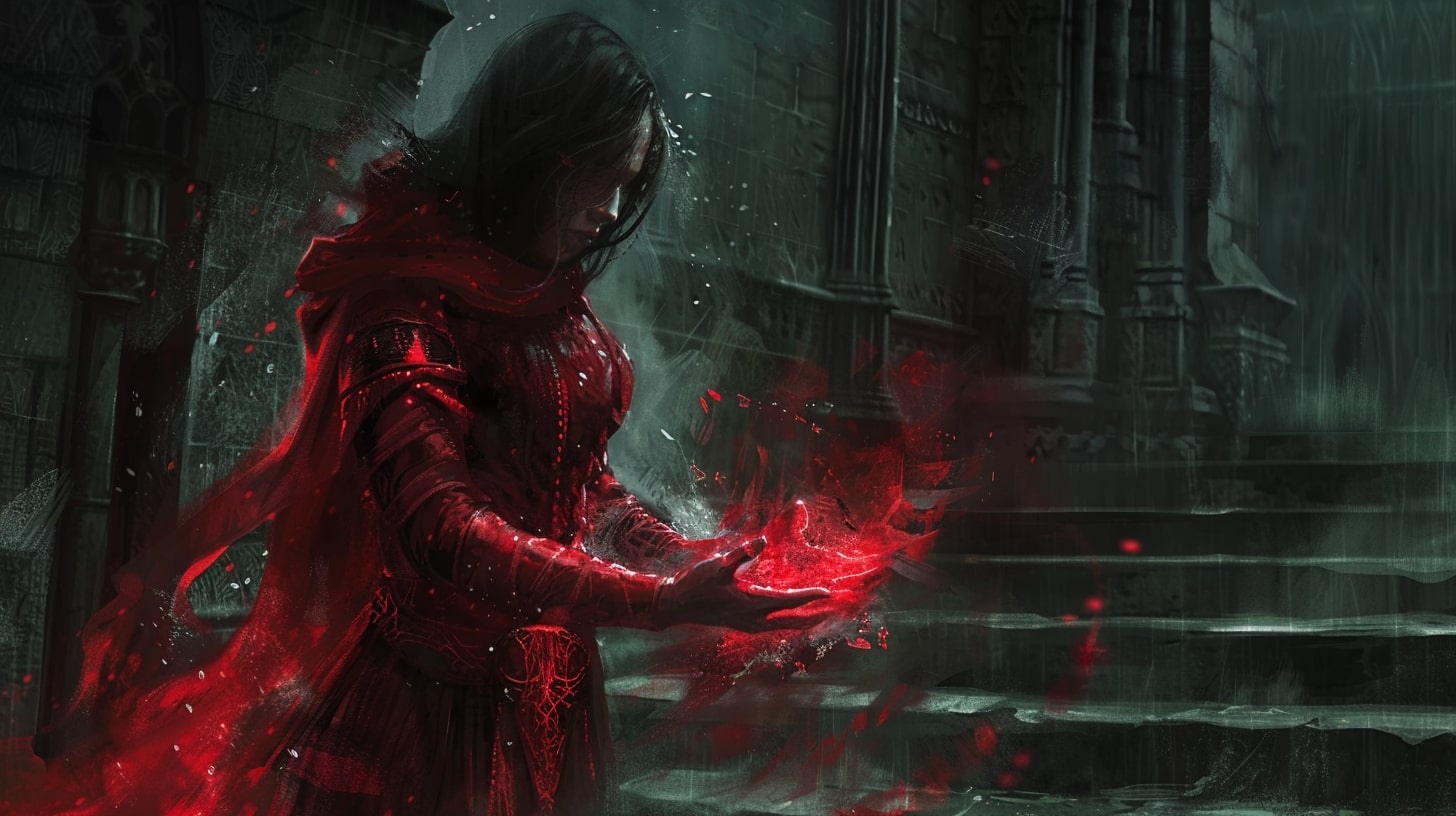
Most magic systems charge for their power with something outside the caster. Mana that refills overnight. A spellbook that runs out of pages. A god who has to be asked nicely.
Blood magic is the one that charges you directly. The cost comes out of the body doing the casting, which means every spell is also a small decision about how much of yourself you are willing to spend.
That is the whole reason blood magic keeps showing up in fantasy and keeps working. Flashy spells are the easy part and the least of it.
The design question that actually matters is what the price buys and who ends up paying it. Get those two answers right and you have a magic system that generates plot on its own. Get them wrong and you have regular magic with a red coat of paint.
This guide is about answering those two questions well. Where the power comes from, what the cost actually is, who pays it, and how a system built on your own blood reshapes the world around it.
If you want the broader groundwork first, the general principles live in our guide to magic systems, and the mechanics of constraint are covered in magic system rules. Blood magic is a specific case of both, and it is a case worth studying because the cost is so unusually personal.
Why blood magic hits differently
Watch what your body does when it sees blood outside of a body. It flinches. That reaction is doing free work for you as a writer.
Readers already believe blood is important because they are built to. You do not have to explain why spilling it should matter. Fire magic has to earn its stakes. Blood magic starts with them.
That is the advantage. Here is the trap that comes with it. Because the reaction is automatic, it is easy to lean on the flinch and never build anything under it.
A character cuts their palm, mutters something, a door opens. The blood was set dressing. Nothing was actually spent. The scene would read exactly the same if they had waved a wand.
The fix is to make the blood a real transaction with a real balance.
In Robin Hobb's Farseer books, the Skill and the Wit both draw on the practitioner in ways that leave them wrung out, and the "Skill-hunger" that follows heavy use is a genuine addiction the characters have to manage for the rest of their lives. In N.K. Jemisin's Broken Earth trilogy, orogenes move the earth by drawing heat and force from their surroundings, and when they run short, the power reaches into their own bodies and other people's without asking.
The magic is not free and the ledger is written in flesh. That is the target. The blood is the material the spell is built out of, not a prop that flips a switch to unlock it.
Where the power lives
Before you decide what blood magic does, decide what blood is in your world. This is the foundation everything else stands on, and most systems that feel thin are thin right here.
They never answer the question. Blood ends up meaning nothing in particular, a red substance you burn to make things happen, and a magic that means nothing in particular can never develop a personality.
Blood carries at least four things a magic system can plausibly draw on, and picking which one you mean changes the entire shape of the system.
- Life force. Blood is the fuel of the body, so spending it is spending vitality directly. This is the version where casting ages you, weakens you, or kills you outright. Clean, brutal, easy for readers to track.
- Lineage. Blood carries heritage, so it carries whatever your ancestors carried. This is the version where a bloodline is a key, where royal blood opens doors commoner blood cannot, where a curse rides down the generations. It ties your magic to family and inheritance instead of raw power.
- Identity. Blood is uniquely yours, which makes it a signature. This is the version where a drop of someone's blood is a leash on them, where a true name lives in the veins, where sympathy and contagion do the work. Powerful, and dangerous to characters in a very intimate way.
- Memory and experience. Blood as a record of what a person has lived. This is rarer and stranger, and it lets you build magic where drinking or reading blood transfers what someone knew or felt. It borders on the kind of residue-based system I have written about elsewhere, where the cost is what you take from a person, not just what you spend of yourself.
You do not have to pick only one. But you do have to pick a primary one, because it determines what the magic can never do.
If blood is life force, then no amount of skill lets a mage cast for free, because the constraint is physical. If blood is lineage, then a talented outsider simply cannot do what a mediocre heir can, and that unfairness is the point.
The best blood magic systems feel inevitable because everything traces back to a single clear idea about what blood means. Sanderson's first law of magic systems is really about this. The reader has to understand the rules well enough to feel the cost land.
When blood means one specific thing, every scene reinforces it, and the reader learns the rules without a lecture.
What the price actually buys
Here is where the design work really is. "Blood magic costs blood" restates the name and calls it a mechanic. The question that matters is what spilling the blood does to the person spilling it, and the answer needs to be more interesting than a scraped knuckle.
Think of the cost as a purchase. The caster is buying an effect, and the currency is some part of themselves.
What part, and whether they get it back, is the entire texture of your system. A useful way to think about it is to separate the costs by what they draw from.
| Cost type | What it draws from | Recovers? | Story engine it creates |
|---|---|---|---|
| Vital cost | The body's health and lifespan | Slowly, or never | Escalation. Every big spell is a countdown on the caster. |
| Physical mark | Scars, disfigurement, visible change | No | Identity. The magic is written on the body for everyone to read. |
| Cognitive cost | Memory, focus, sanity | Rarely | Dread. The caster loses the self that would notice the loss. |
| Relational cost | Bonds, standing, being trusted | Depends | Isolation. Power drives a wedge between the mage and everyone else. |
| Moral cost | Whose blood, and how it was taken | Never | Corruption. The line moves a little each time it is crossed. |
The richest systems combine two or three of these, and the combination is where the character work happens.
A vital cost alone is just a hit-point meter. A vital cost plus a moral cost is a character deciding whether to bleed themselves or someone weaker, and choosing wrong when they are desperate. That decision is a scene. The mechanic wrote it for you.
Here is one way that combination can be nailed down into a rule. Say your world runs on a single law: blood pays for what it can no longer give the body it came from.
A cut hand buys a small working and costs you a day of strength. A cup of your own blood buys something large and costs you a year off the far end of your life, quietly, with no way to feel it leaving. The debt is always collected, and it is always collected in the same coin the blood would have spent on you.
Now put a healer named Vess at a bedside with a dying child and a knife. She has bled herself gray already, and the working she needs is a cup, not a cut. Her own cup would take a decade she does not have left.
The child's mother is asleep in the chair, one arm loose over the blanket, warm and full and unspent. Vess sits with the knife a long time.
The rule did not tell her what to do. It only made sure that whatever she chooses, someone pays exactly what the magic is worth, and she will spend the rest of the book knowing the price to the ounce.
The moral cost deserves its own attention, because it is what separates blood magic from every other power source. Once you allow that other people's blood also works, and works better, you have built a temptation directly into the physics of your world.
The mage who only ever uses their own blood is making a choice every single day not to take the easier road. That restraint is character. And the moment they break it, under pressure, to save someone or to win, you have a turning point that grew straight out of the magic system instead of being bolted on.
This is why blood magic and divine magic so often sit on opposite ends of a world's moral map. One asks you to give of yourself. The other, at its ugliest, asks you to take from someone else.
Who pays, and this is the part most writers skip
I want to slow down here because this is where blood magic gets genuinely good and where almost nobody looks.
The obvious answer to "who pays" is the caster. They cut their own hand, they spend their own vitality, the cost lands on the person who chose to cast.
That is the honest version, and it produces the sympathetic blood mage, the one grinding themselves down to protect the people they love. Fine. Real. Do not get me wrong, that character works and there are great books built on him.
But the second you make the magic transferable, the whole system tilts. If a powerful person can spend a weaker person's blood, then blood magic stops being a personal sacrifice and becomes a resource, and resources get organized.
Somebody figures out that the cheapest way to cast is to cast with blood that is not yours. Then somebody figures out how to acquire that blood at scale. Then somebody builds an institution around the acquiring and calls it something respectable.
This is the shape of every extraction economy that has ever existed, dressed up in fantasy. A resource lives in bodies, so the people who want the resource find a way to take it from bodies that cannot refuse, and they build a whole apparatus of contracts and euphemisms to keep from having to look at what they are doing.
Blood magic lets you tell that story literally. The aristocratic house whose power runs on the blood of tenants who owe them. The temple that "accepts offerings." The war effort that drafts bleeders the way ours drafts soldiers.
The moment you decide blood is transferable, you have decided your world has a class structure, whether you meant to or not, because access to other people's blood is access to power and power sorts itself into who has it and who is it.
In my own world Voxalure, the divide is not what you can spend but what runs in your veins from birth. Magic is gated by inborn blood potency, so you are either weak-blooded or Blood-Born, and only the strong-blooded own the symbol-casting and the Academy that teaches it. That inheritance hardened into a blood aristocracy, complete with a Verification Guild that exists to prove whose blood is worth anything. The weak-blooded who try to buy their way in through illegal amplification usually poison themselves doing it.
So the design question underneath "who pays" is really a question about your whole society. Answer it and a lot of worldbuilding falls out for free.
Decide first whether blood magic is something a person does to themselves or something done to people, because that answer sets everything after it. From there you work out who is permitted to spill blood and whose blood is theirs to spill.
Then the law, which was written by someone, with a particular set of people's blood in mind. Then the supply chain, the place the fresh blood comes from when the powerful need more, and the story those powerful people tell themselves so they never have to look at it directly.
You can write a small, personal blood magic system where the only ledger is the caster's own body, and that is a perfectly good book.
But if you want scale, if you want a world, this is the lever. Decide who bleeds for whom and the politics, the religion, and the villains write themselves.
Building the spells so they could only be blood
A test I keep coming back to. Take one of your blood magic spells and ask whether it would still work if you swapped the blood for glowing dust. If it would, the blood is decoration and the spell is generic. The blood has to be load-bearing.
That means the mechanics of casting should reach back to whatever you decided blood is.
If blood is lineage, then a spell should care whose blood it is, and a stranger's blood should be nearly useless while a sibling's is potent. If blood is identity, then a spell cast with someone's blood should be able to find them, bind them, or harm them at a distance, and stealing a person's blood should be a genuine act of violence even before any spell is cast. If blood is life force, then a spell's power should scale with how much you spend and how fresh it is, and a mage bleeding out should be at their most dangerous and their most doomed at the same moment.
A few levers that make blood feel specific rather than swappable:
- Freshness. Blood that has left the body starts losing whatever made it potent. This forces casting to happen close to the wound, in the moment, which keeps blood magic physical and urgent instead of something you prep in advance like a potion.
- Source. Blood from the caster, from a willing donor, from an unwilling one, from a relative, from a magical creature. Each carries different weight and different cost. This single variable gives you an entire spectrum from noble self-sacrifice to atrocity.
- Quantity and threshold. Small workings take a few drops. Large ones take enough to endanger the caster. When the biggest spells require nearly fatal amounts, you have built escalation into the physics, and your climaxes carry real risk without you having to invent new rules for them.
- Willingness. Whether the blood was given or taken changes what the magic will do. Freely given blood might heal where stolen blood can only harm. This turns consent into a mechanic and makes coercion magically visible.
Notice that every one of these is also a story lever. Freshness forces proximity, which forces confrontation. Source builds a moral gradient. Threshold builds tension. Willingness builds theme.
Every lever you add to the magic is a lever the plot can pull later.
For the deeper mechanics of keeping any system consistent and fair, our guide to writing consistent magic system constraints goes further than I can here, but the blood-specific version of the lesson is simple. The rules are only interesting if breaking them costs the character something they did not want to lose.
The cost has to land on the page
You can design the most elegant cost structure in fantasy and it means nothing if the reader never feels it.
The mistake is treating cost as a number the character tracks offscreen. Readers track the character, not the number, so the cost has to show up in the character.
That means the toll is physical and visible. A mage who has bled for their power looks like it. Pallor, tremor, a cabinet full of long sleeves to hide the scarring, the specific tiredness of someone running on reserves they cannot afford to spend.
It means the toll is behavioral. A character who is losing memory to their magic starts writing things down, starts covering for gaps, starts being quietly terrified in ways the people around them mistake for coldness.
And it means the toll compounds. The scariest version of a cost is one that has been accruing for years before the story starts, so that by the time we meet the mage, half of who they were is already gone and they have made a kind of peace with the arithmetic of losing the rest.
The gradual costs are almost always more effective than the dramatic ones. A limb lost in a single ritual is a shocking image and then it is over.
A mind going gray one spell at a time is a dread that lives in every scene, because the reader knows the mage will keep casting, because the mage always keeps casting, because the whole point of the price is that people pay it anyway.
How blood magic reshapes a world
A magic system this personal does not stay contained. If blood is power, then a lot of ordinary things in your world stop being ordinary.
This is worth thinking through even if most of it never makes the page, because it is what keeps the system from feeling like it was dropped in from outside. If you want the wider taxonomy of how different systems ripple outward, our overview of types of magic systems maps the territory. Here is the blood-specific version.
Consider what a world does defensively once blood is currency. People become careful with their own. Barbers and healers and anyone else with routine access to blood become trusted or feared professions.
There are laws about the disposal of it, rituals for it, superstitions that are actually security measures. The wealthy do not let their blood out of their sight.
Somewhere there is a black market in it, and somewhere in that market is blood that was not given freely, and the story of how it got there is one of the ugliest in your world.
Consider what it does to institutions. Religion takes a position, because a religion has to.
Some faiths will call blood magic a desecration of the body and hunt its practitioners. Others will build it into their rites, arguing that giving of your own blood is the highest devotion, which is a beautiful idea until you notice whose blood the temple actually collects.
Governments regulate it, which means they license it, which means they control who gets to do it and tax the rest. And the families who got rich on it early will have spent generations making sure the rules protect what they already have.
A few knots are worth working loose here, because their answers tend to generate plot on their own. Start with policing, since a magic that runs on a single stolen drop is almost impossible to police, and the methods a society reaches for tell you what kind of society it is.
A state that fingerprints newborns and licenses barbers is a different place from one that just executes anyone caught with a lancet. Follow that thread and the rest unspools.
A person publicly known to be a blood mage becomes either an asset the state guards or a target it hunts, and which one decides whether your mages live openly or vanish into hiding. The legality question is really a question about beneficiaries, because whoever profits from blood magic being illegal is rarely the same crowd that profits from it being legal, and the gap between those two crowds is where your factions come from.
Underneath all of it sits the oldest question, the one about the people who wrote the laws and what they already had that the laws were quietly built to protect.
The goal is a world that could not exist without blood magic, where the magic has left fingerprints on the law, the faith, the economy, and the manners.
When a reader can feel that the world grew around the magic instead of hosting it, the system has done its real job.
Where blood magic goes wrong on the page
A few failure modes worth naming, because they are common and each has a fix that traces back to everything above.
The magic that only bleeds when it is convenient. The cost appears in the training montage and vanishes the moment the plot needs the hero to win. If the price is real, it is real in the climax too, and the climax is exactly where it should hurt most.
The cost with no ceiling. If a mage can always bleed a little more to do a little more, there is no tension, because there is no limit they can hit.
The threshold matters. Somewhere there has to be a wall, an amount of blood that is simply too much, so that the reader knows the mage can run out of self to spend.
The system that forgets other people exist. A blood mage who only ever bleeds themselves, in a world where nobody else has noticed that other people's blood works too. That world is not thinking clearly about its own physics. Somebody would have figured it out. The absence of that somebody is a hole in the worldbuilding.
The blood that is only ever gross. Shock wears thin where depth would hold. A spray of gore in every scene numbs fast and buys nothing.
The real horror of blood magic lives in the fact that it works, that it is worth it, that people keep choosing it with clear eyes, and that the choosing is what costs them.
The one thing to hold onto
Blood magic is compelling for a single reason, and every good version of it comes back to that reason. The price is the caster's own body.
Other systems bill a resource the caster owns or a favor the caster is owed. This one bills the self doing the casting. That is why it generates character where other systems generate spectacle.
Every spell is a person deciding what they are willing to spend of themselves, and every world built on it is a place where that decision has been organized, priced, legislated, and fought over.
So when you design yours, spend most of your energy on the two questions that matter. What does the price buy, and who ends up paying it. The spells will follow. The world will follow.
And the scenes where a character stands over their own opened vein and decides to keep going, or stops, or reaches for someone else's instead, those will be the scenes readers remember, because you built a magic system where the most important choice is always the same one, and it is always personal.
FAQ
What is a blood magic system in fantasy writing?
A blood magic system is a set of rules for magic that draws its power from blood, usually the caster's own. What defines it is that the cost is bodily and personal rather than external.
Instead of spending mana or asking a deity, the caster spends part of themselves, which makes every spell a decision about how much of their own vitality, health, or lifespan they are willing to give up.
What should blood magic cost the caster?
The cost should be something the caster cannot easily get back and that the reader can see. Common options are vital cost (health and lifespan), physical marks (scars and disfigurement), cognitive cost (memory and sanity), and moral cost (the choice to use someone else's blood).
The strongest systems combine two or three of these so that casting forces a real decision, not just a hit to a number.
How do I make blood magic feel different from regular magic?
The fastest tell is whether your spells care where the blood came from. In most magic systems a fireball is a fireball no matter who lit it. Blood magic should refuse that.
Write a scene where the same working done with a stranger's blood, a sibling's, and the caster's own produces three different results, or three different prices, and the story now depends on a detail no other power source could supply.
If nothing in your draft changes based on whose blood it is, the magic still belongs to whoever spilled it in name only, and the story would survive intact with the blood taken out.
Is blood magic always evil?
No. Blood magic reads as dark because it involves harm and sacrifice, but a mage who only ever spends their own blood to protect others is heroic.
The darkness enters when the magic becomes transferable and a caster can spend someone else's blood instead. That temptation is a design choice, and keeping a character on the right side of it, or watching them fall, is where a lot of the best blood magic stories live.
How does blood magic affect worldbuilding?
Start from a single everyday object and follow it out. A wet-nurse, a battlefield surgeon, a menstruating teenager, a slaughterhouse drain.
In a world where blood is power, each of those becomes a security question, a tax category, or a target, and mapping who worries about which one hands you a class structure without you having to design one on purpose.
A useful exercise is to write the guild rulebook for whatever profession handles the most blood in your setting, because the clauses that rulebook needs to include, about storage, disposal, chain of custody, and who is allowed in the room, will tell you more about your world's fears than a page of exposition ever could.
What are good examples of blood magic in published fantasy?
Robin Hobb's Farseer books tie magical talent to a genuine, lasting cost on the practitioner, including an addiction that never fully lets go. N.K. Jemisin's Broken Earth trilogy builds power that draws force from the caster's surroundings and body with lethal consequences.
These work because the cost is consistent, visible, and lands on the character, which is exactly what any blood magic system needs to do.