
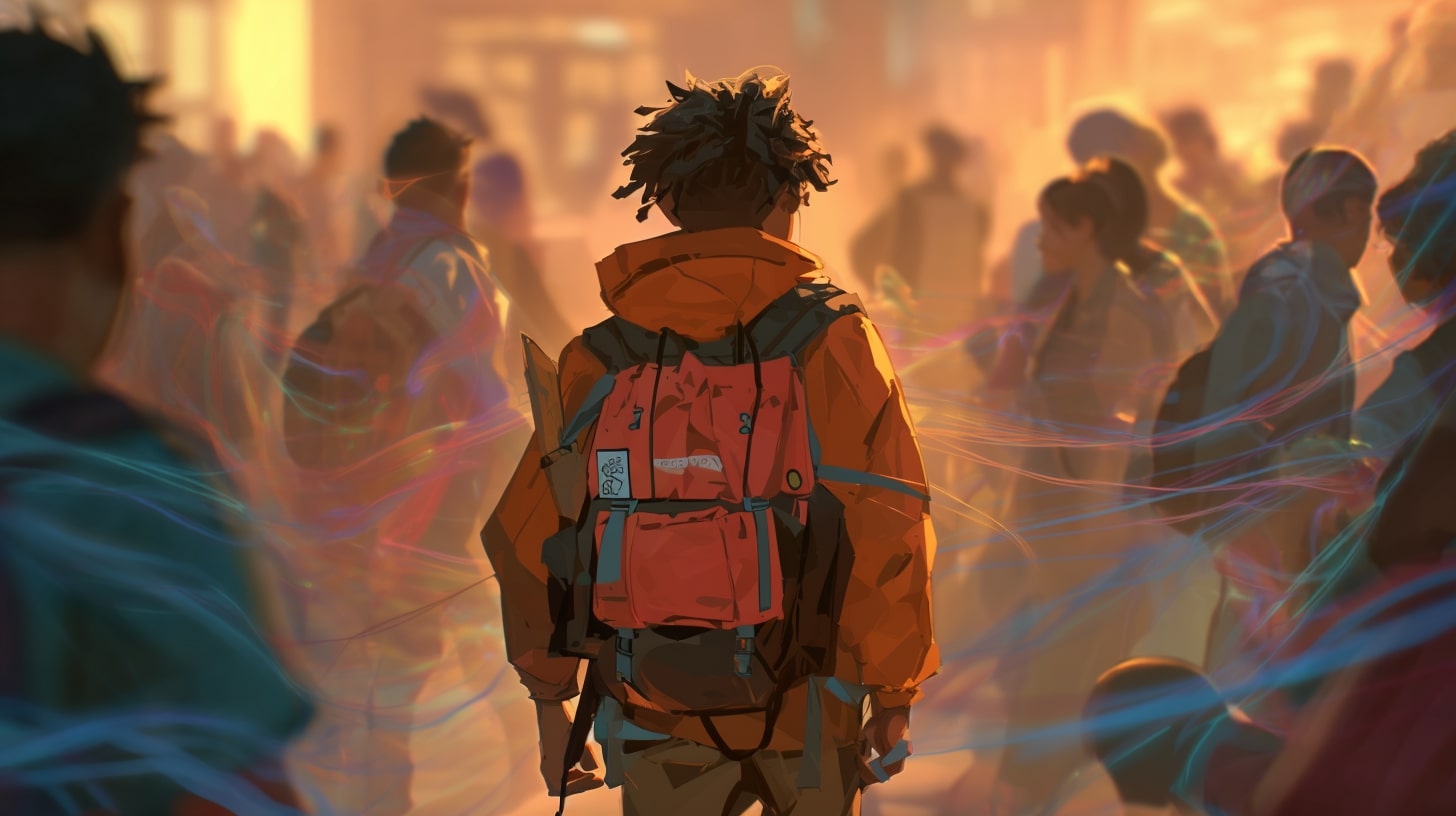
Chapter 8
I woke up to Dao throwing a pillow at my head.
"Breakfast in twenty. Don't be late or they run out of the good eggs."
I sat up and immediately regretted it. The room pressed in from every direction. Last night the accumulated anxiety of former students had felt almost comforting. This morning it just felt heavy.
"What makes the good eggs good?"
"They're not the bad eggs." Dao was already dressed, pulling on shoes. "Trust me. You don't want the bad eggs."
I stumbled through getting ready. The bathroom down the hall was crowded with first-years in various states of consciousness. I kept my head down and my hands close to my body, navigating around people without touching anyone. A few of them glanced at me with curiosity. The mid-semester transfer. Cross's project.
Word really did travel fast.
My phone buzzed on the nightstand as I grabbed my jacket. Shelby. Two texts from this morning, sent before I was even awake.
did you know there's a college that offers a degree in puppetry? PUPPETRY eli. what is happening in this country
And then, twenty minutes later: seriously though how's day 2? surviving?
I should respond. She was trying. Keeping things light because she could tell I needed that.
I put the phone in my pocket without typing anything.
Breakfast was in the same dining hall as last night, but the morning crowd was different. Less social, more functional. People shoveling food and staring at notes. A girl at the next table was clutching a small stone, rubbing her thumb across its surface in slow circles. As I watched, the stone pulsed with a faint amber glow, barely visible unless you were looking for it. She closed her eyes and her breathing steadied, whatever stress she'd been carrying seeming to drain away into her shoulders.
Across the room, a guy touched something in his pocket before turning a page in his textbook. When his hand emerged, there was the faintest shimmer around his fingers, like heat rising off summer pavement. It faded before he finished the gesture.
Tokens. I was watching people use their tokens, and for the first time I could actually see them working. Not dramatically. Nothing that would make a normal person look twice. But the magic was there if you knew how to look.
The good eggs were indeed better than the bad eggs, though I couldn't have explained why. Something about the texture.
Sasha found us before we finished eating. She had a schedule printed on actual paper, which she slid across the table to me.
"Your classes. Cross had it sent to my room since I'm apparently your unofficial orientation guide now."
"Thanks. I think."
"Don't thank me yet. You're behind in everything. The semester's half over and you haven't taken any of the foundational courses." She tapped the paper. "You have Echoes first period. That's the one that matters most."
"Echoes?"
"Learning to read places. The foundation of everything else we do here."
Dao and Sasha exchanged a look I couldn't interpret.
"What?" I asked.
"Nothing," Dao said. "Just... good luck."
Echoes met in a basement classroom that had probably been something else before it was a classroom. The walls were old stone, damp in places, and the ceiling was low enough that the taller students had to duck through the doorway.
The instructor was a thin woman named Professor Aldridge who looked like she'd been teaching this course since the building was new. When she walked past me to the front of the room, I felt something I hadn't expected. Weight. Density. Like the air around her was thicker than it should be. Decades of accumulated experience radiating off her in waves.
She nodded at me when I sat down. "Mr. Lawrence. We'll see what you can do."
There were maybe fifteen other students, all first-years, all watching me with varying degrees of interest. I found an empty chair near the back and tried to become invisible. It didn't work.
"Since we have a new student," Professor Aldridge announced, "let's do a practical demonstration. Everyone to the practice room."
Students stood, and I noticed several of them touch things before they moved. A bracelet. A ring. One girl pressed her palm flat against a worn leather bookmark, and for a moment the leather glowed faintly gold, like embers catching breath. When she tucked it into her pocket, she moved differently. More confident. More centered. Small rituals I was only now starting to understand.
The practice room was through a door I hadn't noticed. It was smaller than the classroom, empty except for bare stone walls, and it felt different the moment I stepped inside. Heavier. Like the air had weight.
"This room has been deliberately saturated," Professor Aldridge explained. "Generations of students have used it for exercises. The experiences stored here are layered and complex. Your task is to read them."
The other students spread out around the room. Some closed their eyes. Others pressed their hands against the walls.
What happened next made me understand why everyone had looked at me with pity.
The girl with the leather bookmark touched the stone first. Her eyes went distant, reflecting something that wasn't in the room. Around her fingers, the air shimmered like summer haze, and the wall seemed to respond. A faint pulse of warmth spreading out from her palms. She started speaking in fragments.
"...scared, couldn't breathe, then it clicked and she finally understood how to..." Her voice trailed off as she went deeper.
Across the room, a tall boy with his hand pressed flat against the opposite wall had gone very still. The temperature around him dropped noticeably, and when he exhaled, I could see his breath. His eyes were closed but moving, tracking something invisible.
Another student murmured dates. "1987... no, older... 1952, there was a fire somewhere close by, I can taste the smoke..."
One by one, they sank into the walls like divers slipping beneath dark water. And one by one, the magic became visible. Faint glows around their hands where they touched the stone. Air shimmering and distorting. Temperature shifts that made the room feel like it had weather. They were reading decades of accumulated experience, and the room was talking back.
I tried to do the same.
I pressed my palm against the cold stone. Closed my eyes. Reached for whatever they were reaching for.
Nothing. My hands stayed ordinary. The stone didn't glow, didn't warm, didn't respond. I felt the same blur I always felt when I tried to read places. A pressure against my awareness, like being in a crowd where everyone was talking at once. But when I tried to focus on it, tried to read the room the way the others were reading it, I got nothing but fog.
No. Not nothing. Fragments.
A student who'd stood in this corner fifty years ago, frustrated and scared. Another one near the door, proud of something she'd finally learned. A professor who'd taught here when the stones were newer, his impatience still somehow present.
People. I was reading the people who'd been here, not the room itself.
"Mr. Lawrence." Professor Aldridge was standing beside me. Up close, that weight was almost overwhelming. Everything she'd ever felt, everyone she'd ever taught, pressed against my awareness like standing too close to a bonfire. "What do you perceive?"
"People," I said. "Students who practiced here. A teacher. Their emotions."
"And the saturation itself? The accumulated experience stored in the stone?"
"I can feel that something's there. But I can't... I can't read it directly. Only the traces people left behind."
Professor Aldridge's expression was hard to interpret. "You're reading the human residue. The emotional echoes of individuals. That's not the same as reading place-memory."
"I know."
Around the room, students continued their readings. The girl with the bookmark had gone deeper, her hands now glowing steadily, warmth radiating off her like a small furnace. The tall boy was shivering but still connected, still pulling something from the wall that made his breath come in visible puffs.
"Can you distinguish between layers? The older traces versus the newer ones?"
I tried. Pushed my awareness deeper, looking for strata, for the geological structure everyone else seemed to perceive naturally.
"Maybe? There's a thickness to some of it. Like it's been here longer." I shook my head. "But it's all just people to me. I can't feel the room itself."
Professor Aldridge watched the girl with the bookmark for a moment. "Ms. Chen. Show us what you found."
The girl's eyes refocused slowly, like waking from a deep dream. "A student from the 1960s. She was the first person in her family to show the gift. The room remembers how hard she worked to prove herself."
"And how did accessing that feel?"
"Warm. Determined. Like borrowing someone else's resolve."
Professor Aldridge nodded approvingly. "Your token helped you connect?"
"Yes, ma'am." The girl touched her pocket where the leather bookmark rested. "Like... like turning up the volume on something I could barely hear before."
She turned back to me. The contrast couldn't have been clearer. Ms. Chen, connected, glowing, drawing something real from the stone. Me, standing there with ordinary hands and a blank wall that didn't want to talk.
"Cross mentioned you were unusual," Professor Aldridge said finally. "I didn't realize she meant foundationally unusual."
"Is that bad?"
"It's not good or bad. It just means the standard curriculum won't work for you. We'll need to find another approach." She turned back to the class. "Everyone else, continue the exercise. Mr. Lawrence, observe. Try to understand what the others are doing even if you can't replicate it."
So I stood there and watched. Watched my classmates read layers I couldn't see, describe experiences I could only glimpse as fragments. Watched the room respond to them with glows and temperature shifts and visible magic while I stood there like a tourist pressing my nose against glass.
The good eggs sat heavy in my stomach.
Second period was Threshold Studies.
The classroom was on the third floor of the east wing, and it looked like someone's attic had exploded. Maps covered every wall, some of them clearly old, others hand-drawn on notebook paper. Shelves held objects that didn't seem to belong together, and some of them hummed with visible residue. A brass compass next to a child's snow globe, both radiating faint but distinct colors. A chunk of what looked like railroad track beside a delicate glass vial filled with something that shimmered actively when light hit it, swirling and pulsing like a living thing.
Professor Blackwood stood at the front, and he was nothing like Aldridge.
Where she'd felt dense with accumulated weight, Blackwood felt scattered. His attention jumped from thing to thing like a hummingbird, his hands constantly moving, picking up objects from his desk and putting them down again. He wore a tweed jacket that had seen better decades and his gray hair stuck up at angles that suggested he'd forgotten mirrors existed.
"Ah! The new student!" He beamed at me like I was a present he'd been hoping for. "Lawrence, yes? Cross mentioned you. Sit anywhere, sit anywhere. We're discussing transit theory today, which sounds dull but isn't. Nothing about portals is dull, I promise you that."
I found a seat near the middle. The students around me seemed relaxed in a way they hadn't been in Echoes. A few were smiling.
"Now then." Blackwood picked up what looked like an ordinary doorknob. "Who can tell me why this matters?"
A student in the front row raised her hand. "It's from the Bellingham Gate?"
"Exactly! Exactly right. The Bellingham Gate, which operated from 1847 to 1912, connecting Portland to a lovely spot in the Swiss Alps. Closed now, of course. Tragic business. But the doorknob remains." He held it up to the light, and I could see it now. The brass wasn't just old. It was saturated, carrying a faint golden shimmer that pulsed when Blackwood's fingers wrapped around it. "Everything that ever passed through that gate left traces in this brass. Sixty-five years of travelers. Their hopes, their fears, their terrible fashion choices."
A few students laughed.
"Portals aren't just doorways," Blackwood continued, setting the knob down and picking up a folded map. "They're relationships. Between places. Between the people who use them. Between the here and the there." He unfolded the map, revealing a web of lines connecting points I didn't recognize. "The portal network is alive. It remembers. And sometimes, if you're very clever and very careful, it talks back."
He spent the rest of the period walking us through the basics of threshold theory. How portals worked. Why some connections were stable and others weren't. The history of the major gates and the practitioners who'd built them. I understood almost none of it. But unlike Echoes, that was fine. This was information, not ability. I could learn information.
When class ended, Blackwood caught my arm. "Lawrence. A word."
I stayed while the other students filed out. The doorknob from the Bellingham Gate sat on his desk, still pulsing with that subtle golden light.
"Cross tells me you have an interesting gift." His eyes were brighter than they'd seemed during class. More focused. "Reading people instead of places."
"That's one way to put it."
"It's a rare way to put it. In thirty years of teaching, I've met exactly two practitioners who couldn't read place-memory at all." He picked up the doorknob, turned it over in his hands. "Both of them found other paths. Neither of them were limited by what they couldn't do. They were defined by what they could."
"That's encouraging. I think."
"It's meant to be. Cross recruited you for a reason, Lawrence. Don't assume that reason was traditional." He set the doorknob back down. Then his expression shifted. Became more serious. "One other thing. Be cautious about strangers approaching you. On campus, off campus, anywhere. There are practitioners outside these walls who would exploit your gifts. Especially a gift like yours."
"What kind of practitioners?"
"The kind who see potential as something to harvest rather than nurture." He waved a hand, dismissing the topic before I could ask more. "It's nothing to worry about right now. Just be aware. Now get to lunch. The afternoon doesn't get easier."
Lunch was with Sasha, Dao, and Thaddeus. They'd apparently adopted me without consulting me first.
"How bad was Echoes?" Sasha asked.
"I'll survive."
"That bad?"
"Everyone's hands were glowing except mine. One guy made his breath visible from the cold. I stood there like an idiot while the walls refused to talk to me." I poked at my food. "So yeah. Great start."
"Blackwood was better," Dao guessed.
"Blackwood was fine. He talked a lot about portals and I understood maybe twenty percent of it, but at least I didn't feel like a complete failure."
Thaddeus leaned forward. "Have you declared for a Sign yet?"
"I don't know what that means."
"The four halls," Dao said. "Hearth, Thorn, Gate, and Tide." He ticked them off on his fingers. "Every student eventually declares for one. It's part of how they track your development, match you with mentors, all that."
"First-years are technically Unmarked," Sasha added. "But most people start feeling a pull toward one Sign or another pretty early. The halls have different flavors. Different kinds of saturation. You're supposed to visit all four and see which one resonates."
"And if none of them resonate?"
She and Thaddeus exchanged a glance.
"They usually do," Thaddeus said carefully. "Eventually."
I thought about yesterday. The Portal Hall with its dozen doorways, each one tugging at me in a different direction. All those whispers I couldn't quite hear.
"What if someone feels pulled toward more than one?"
Dao laughed. "That doesn't really happen."
"Why not?"
"Because the Signs are different. Really different." He gestured with his fork. "Hearth is about homes and belonging. Thorn is about boundaries and protection. Gate is about connections and passage. Tide is about change and flow. They're not compatible flavors. You might have a mild interest in a second Sign, but when you feel yours, you know."
"Everyone says that," Thaddeus agreed. "It's like asking what if someone's favorite color is all of them. You just... have one that feels more right than the others."
I filed that away, troubled by how little it matched what I'd felt. In the Portal Hall, every doorway had pulled at me. Not equally, but none of them had felt wrong either. More like they were all speaking the same language and I just couldn't understand any of them yet.
Great. Another thing I probably couldn't do the normal way.
"I'll add it to the list," I said. "Right after 'learn to read places' and 'stop being foundationally unusual.'"
Afternoon brought Drift.
I'd heard the word mentioned since I arrived but hadn't really understood what it meant. Now, standing at the edge of an outdoor field roughly the size of a soccer pitch, I started to get the idea.
Capture the flag. That's what it was. Two flags on poles stuck in the ground at opposite ends of the field, fabric snapping in the October wind.
But the field itself was wrong.
Not wrong exactly. Alive. Saturation pools shimmered across the terrain like heat distortion or oil on water. Some were obvious, bright patches that even I could vaguely perceive if I squinted. Others were subtle, barely-there ripples that my classmates pointed at while I saw nothing. The pools appeared, faded, shifted. A spot that looked empty suddenly bloomed with visible energy. A patch that had been bright a moment ago went dark.
"Drift is capture the flag," Coach Vasquez said. He was a compact man with the energy of a compressed spring. "Grab theirs, get it back to your side. First to capture wins. Simple."
It did not look simple.
"The field is saturated. You draw from the pools to power yourselves up. You push to release that energy at opponents." He gestured at a student near the front. "Demonstrate."
The student, a girl with her hair pulled back in a tight braid, walked to the nearest visible pool. She stepped into it, and I watched the shimmer flow toward her like water finding a drain. It absorbed into her hands, her arms. For a moment she glowed faintly, holding something I could almost see.
"That's drawing," Vasquez said. "Now push."
She extended her hand toward a practice dummy at the edge of the field. The air between them rippled, a visible wave of force that made my eyes water. The dummy rocked backward, nearly toppling. And the girl dimmed, the glow fading as she released what she'd gathered.
"You push at opponents, they freeze. Can't move for a few seconds. Enough freezes and you're running the flag home unopposed." Vasquez scanned the group. "No assigned positions. Your team figures out who does what. Some people see the pools clearly, so they call the field. Some people are fast, so they run. Some people hit hard, so they guard. Figure out what you're good at and do that."
He split us into practice squads. Five per team. I ended up with Dao, Sasha, Thaddeus, and a guy named Marcus Holloway who looked like he'd rather be anywhere else. Old family name, expensive clothes, and an expression that suggested we were all beneath his notice.
"Alright," Sasha said as we huddled. "Who can see the pools clearly?"
Marcus shrugged. "I can."
"So can I," said a girl from another squad who was close enough to overhear. She smirked at us. "Good luck."
"Anyone else?" Sasha looked around. Her eyes landed on me. "Eli. You're a reader, right? Can you see them?"
I looked at the field. Really looked. The obvious pools were there, sort of. Bright smears that I could almost track. But the subtle ones, the ones my classmates were pointing at and discussing like they were labeled on a map, might as well have been invisible.
"Barely," I admitted. "The big ones, maybe. The rest... it's like trying to read through fog."
"Great," Marcus muttered. "We've got a blind caller."
"I'm not calling anything. I can't see well enough to—"
"Someone has to." Sasha cut me off. "Marcus, you said you can see them?"
"I can see them fine. I'm not spending the whole match yelling directions." He crossed his arms. "I'm fast. I'll run the flag."
Dao bristled. "So you'll just do whatever you want and leave us to figure it out?"
"Pretty much."
"Eli." Thaddeus spoke up, his voice calm. "You read people, right? Not just places?"
"Yeah, but—"
"Can you tell what the other team is planning? Where they're going to move?"
I hadn't thought about it that way. I looked across the field at our opponents, already huddled and strategizing. Their caller, a girl named Priya who I'd heard was good, was pointing at different sections of the field. I couldn't hear what she was saying, but I could feel her attention. The way it moved across the terrain, tracking things I couldn't see.
"Maybe," I said slowly. "I don't know. I've never tried."
"Worth a shot." Thaddeus looked at Sasha. "You're analytical. You call our positioning based on what Eli tells us about them. I'll guard our flag. Dao, you're fast too. You and Marcus run."
"I don't take orders from—" Marcus started.
"It's a practice match," Sasha said flatly. "No one cares about your family name here. Either help or get out of the way."
Marcus's jaw tightened, but he didn't argue.
The whistle blew.
The other team moved immediately. Priya called something I couldn't hear, and her squad flowed across the field like they'd rehearsed it. Two runners sprinting wide, a guard settling near their flag, and Priya herself tracking the field with visible confidence.
"They're going left," I said. I could feel Priya's attention shift that direction, feel the decision form in her mind half a second before her runners committed. "Both runners, wide left approach."
"Dao, intercept!" Sasha called.
Dao took off, but he was already behind. The other team's runners had hit a pool I hadn't seen, drawing power that made them faster, brighter. Dao met them in the midfield and got hit with a push that staggered him sideways. He froze in place for two terrible seconds while they flowed past.
"Another pool, right side!" someone on their team yelled. Their guard was drawing, building power, getting ready to hit whoever came for their flag.
Marcus ran anyway. He was fast, I had to give him that. But he was running blind, ignoring Sasha's calls, heading straight into a dead zone I couldn't see until he was already in it. His steps faltered. No power to draw from. Their guard hit him with a push and he went down hard.
"Where are the pools?" Sasha demanded, looking at me.
"I don't know! I can barely—"
"Then tell me where THEY'RE getting power. Watch Priya. Where's her attention?"
I tried. Focused on Priya across the field, felt her reading the terrain, felt her attention move to a spot near our flag that looked empty to me but clearly wasn't.
"There's something near our flag. Southwest corner. Priya just spotted it, she's sending—"
Too late. Their runner was already there, drawing from a pool that bloomed visible for a moment as the shimmer flowed into her. She lit up, powered up, and then she was sprinting for our flag while Thaddeus tried to intercept.
He got a push off, but she was ready. Blocked it somehow, kept moving. Grabbed our flag. Started running.
Dao had unfrozen by then. He chased her down, but without a pool to draw from, his push was weak. She stumbled but didn't stop. Made it back to her side.
The whistle blew.
"Point," Vasquez called. "Reset."
We lost three to nothing.
Afterward, Coach Vasquez pulled me aside.
"Your perception is atypical."
"So I've heard."
"You can't see the pools. That's a problem."
"I know."
"But you were tracking their caller. I saw you watching her, calling their movements before they committed." He studied me with something that might have been interest. "That's not how Drift is usually played."
"It didn't help. We still got destroyed."
"Because you were trying to do two things at once. Read their caller AND translate that into positioning for your team. That's too much for one person who's still learning what they can do." He crossed his arms. "Figure out how to make it work or figure out something else. Your team needs you contributing, not spectating."
"How am I supposed to contribute if I can't see the field?"
"That's your problem to solve. Not mine."
He walked away to talk to another squad.
I stood at the edge of the field and watched other teams run drills. They moved with coordination, their callers pointing at pools I couldn't see, their runners drawing and pushing in visible bursts of power. The shimmer flowing toward outstretched hands, the air rippling with released force, the brief freezes when a push landed clean.
Real magic. Visible, tangible, beautiful.
And I was standing outside it, nose pressed against glass, wondering if I'd ever find a way in.
After dinner, I walked. I didn't have a destination. I just needed to be somewhere that wasn't the dining hall or my room or anywhere else full of people who could do what I couldn't.
The grounds were larger than they looked from inside. Paths wound between buildings and through gardens that were probably beautiful in spring. Now, in October, everything was going brown and brittle. Leaves skittered across the paths in the evening wind, and the trees had thinned enough that I could see the sky going dark between their branches. I passed the building Thaddeus had mentioned housed the Sign halls. Four wings branching off a central rotunda. I should probably go in. Feel whatever I was supposed to feel. Find where I belonged.
I kept walking.
I ended up at the lake.
The water was dark and still. Trees crowded the shore, their bare branches reaching toward a sky going purple with dusk. Students were warned about this place, though no one had told me exactly why. I sat on the bank and stared at the water and tried to feel something other than defeated.
The lake didn't feel like the practice room. It didn't feel like the dining hall or the dormitory or any of the saturated spaces I'd been thrown into since arriving. Those places felt layered with human experience, thick with emotion and memory pressed into stone.
This felt different. Deeper. Less human.
I found myself leaning closer to the water without meaning to. The surface was perfectly still, reflecting the darkening sky like polished obsidian. I had the strangest urge to touch it.
My fingers brushed the surface.
Cold. Immediate, sharp cold, but something else too. Something underneath the cold that I didn't have words for. An age that made the practice room's centuries feel like yesterday. A patience that had nothing to do with human timescales. For just a moment, I felt the lake the way I felt people. Not its history, not its memories, but something like its intention.
Waiting.
The word came from somewhere I couldn't identify. Not a voice, not exactly. More like understanding that arrived without being invited.
I jerked my hand back, heart pounding.
The water was still. Just water. No ripples, no indication anything had happened.
But I'd felt something. For the first time since arriving at Mudwick, I'd felt a place instead of just the people who'd been there. Not clearly. Not the way the other students read saturated spaces. Just a flash.
A place had finally talked to me, and it had been the one place everyone said to avoid.
"You shouldn't be out here alone."
I didn't jump. I'd felt Sasha approaching, her particular emotional signature becoming familiar enough to recognize.
"Everyone says that. No one says why."
"Because no one knows exactly why." She sat down beside me, keeping a careful distance from the water. "Just that people who spend too much time at the lake start hearing things."
"What kind of things?"
"Voices. Whispers. Some people say it's old spirits. Some people say it's just the saturation playing tricks. Either way, the school discourages solo visits."
"And yet here you are."
"I come here to think sometimes. When the main buildings get too crowded." She looked out at the water. "I grew up in a house with six people and one bathroom. Quiet space is valuable to me."
We sat in silence for a while. I didn't tell her what I'd felt when I touched the water. I wasn't sure how to explain it. Wasn't sure I hadn't imagined it.
"I heard about Drift," Sasha said eventually.
"Word really does travel fast."
"I have sources." She pulled her knees up to her chest. "You're struggling because the game assumes you can do something you can't do."
"That's one way to put it."
"It's the accurate way. Drift is built around reading the field. If you can't read the field, you're playing with half the information everyone else has."
"Thanks. That's very encouraging."
"I'm not trying to encourage you. I'm trying to understand the problem." She turned to look at me directly. "You read people. Their emotions, their intentions, even their decisions before they make them. That's what you did today. You called their movements before they happened."
"And we still lost."
"Because you were trying to do my job at the same time. Translate your reads into tactics. That's not your strength." She paused. "What if you just fed me raw information? What Priya's looking at, where her attention is going, what she's about to call. Let me turn that into positioning."
"That's still not seeing the pools."
"No. But it's seeing through someone who can." She stood up, brushing dead leaves off her clothes. "You can read people. That's not nothing. That might even be something important. But you're never going to figure out what it's good for if you sit by this lake feeling sorry for yourself."
"I wasn't feeling sorry for myself."
"You absolutely were. And you're allowed to, for a little while. Today sucked. But tomorrow you get up and you figure out how to make what you have work for what they need." She offered me a hand without thinking, then pulled it back. "Sorry. Habit."
"It's fine." I stood up on my own. "You're surprisingly good at pep talks for someone who says she's not trying to encourage me."
"That wasn't encouragement. That was tactical analysis." But she almost smiled. "Come on. It's getting dark, and I wasn't joking about the lake. Whatever's in there, I'd rather not find out firsthand."
We walked back toward the main buildings together. The grounds were quiet now, most students inside for the evening. The weight of the place pressed against me from every direction, but it felt more manageable with someone beside me.
"Sasha."
"Yeah?"
"Thanks."
"Don't thank me yet. I still have questions about your abilities. I'm going to want to run experiments."
"Of course you are."
Back in my room, Dao was already asleep, his breathing slow and even. I sat on my bed in the dark and pulled out my phone.
Fourteen texts from Shelby now. The morning ones I hadn't answered, plus more throughout the day.
The first few were memes. Our thing. She'd sent a screenshot of a cat looking judgmentally at a cucumber with the caption "me watching you abandon me for rich people school." Then a TikTok link I couldn't watch without wifi, with her commentary: "this is literally us at Denny's that one time."
The one time we'd accidentally convinced a waiter we were food critics and gotten comped dessert. I could still picture her trying not to laugh while describing the "textural notes" of her pancakes.
Then the questions started. how's fancy boarding school? Then another. hello? Then: you alive out there?
The last one was from an hour ago. starting to think you got kidnapped by rich people. blink twice if you need rescue.
I stared at the screen. She'd been texting all day, and I'd ignored every single one. Not because I didn't want to talk to her. Because I didn't know how to explain a world where walls talked and lakes whispered and I was the only person who couldn't do what everyone else could.
I typed: sorry, crazy day. still alive. definitely not kidnapped. tell you about it later.
I didn't know when later would be. I didn't know how I'd ever explain any of this to someone who lived in the normal world, where the worst thing that happened was Brianna Hollister being passive-aggressive about mall invitations.
Three dots appeared. Shelby typing.
better be a good story. i've been saving memes for DAYS. also that cucumber cat absolutely nailed your vibe today I could tell
I almost smiled. She always could tell.
it will be, I wrote back. promise.
A promise I didn't know how to keep. Another thing added to the list of ways I was failing people who cared about me.
I put the phone down and lay back, staring at the ceiling. The traces of anxious students pressed in from the walls, their old fears familiar now.
Tomorrow I would fail again, probably. The curriculum wasn't built for someone like me and that wasn't going to change overnight.
But Sasha was right. I could read people. That wasn't nothing.
And Blackwood was right too. Some of the most interesting practitioners didn't fit the standard mold.
And then there was the lake. That flash of something. That moment where a place had finally responded to me, even if I didn't understand what it meant.
I was starting to see the shape of something. A way forward that nobody had mapped yet because nobody like me had ever needed it before.
I fell asleep thinking about what it might look like.