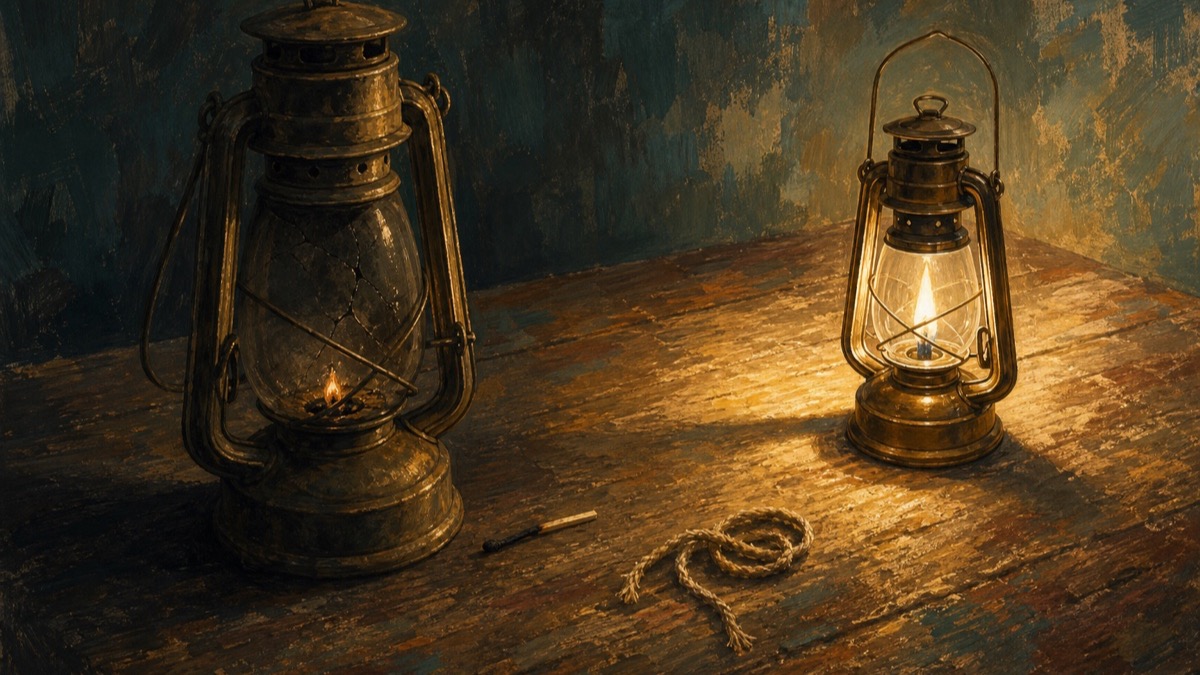
A mentor who can solve the problem has just removed your story.
That is the constraint under every piece of mentor advice you have ever read, and most of them never say it out loud. They talk about wisdom and guidance and the bond between teacher and student.
What they skip is that the entire archetype is an engineering problem. You need someone knowledgeable enough to matter and limited enough to leave.
Everything interesting about mentors comes out of that tension. Get it wrong and you have written a character who is standing right there, fully capable, while your protagonist struggles with something the mentor could fix in an afternoon.
Why the Mentor Has to Be Removed
Obi-Wan dies. Gandalf falls in Moria. Dumbledore goes off the tower. Haymitch cannot enter the arena.
None of that is sentiment. The hero cannot own the ending while the person with the answers is still standing next to them. Every mentor death people cry about is a structural necessity dressed up as tragedy, and the reason they land emotionally is that the story spent hundreds of pages making you need that character exactly as much as the protagonist did.
The removal is not a plot event you add for feeling. It is the moment the training stops being theoretical.
Which is why the timing matters more than the method. Remove the mentor too early and the hero has not learned enough to survive, so the reader stops believing in the climax.
Remove them too late and the hero never gets a scene where the outcome is genuinely theirs. The mentor should leave at the point where the hero has the tools and has not yet proven they can use them.
Four Honest Ways to Get Rid of Them
There are more than four, but these are the ones that do not feel like the author panicking.
| Method | What it costs the story | When to use it |
|---|---|---|
| Death | Highest emotional payoff, but it is the most used and readers see it coming from the moment a kindly old teacher appears | When the mentor's absence needs to be permanent and the loss itself is a lesson the hero has to metabolize |
| Betrayal | Retroactively poisons every lesson, which is expensive and powerful, and it demands the earlier scenes hold up on a reread | When your theme is about trust, institutions, or the danger of accepting a worldview wholesale |
| Being wrong | Cheapest to stage and the hardest to write well, because the mentor has to be wrong in a way that was reasonable | When the hero's growth is about judgment rather than skill |
| Being outgrown | No dramatic event at all, which makes it feel truest to life and gives you the least momentum | When the relationship itself is the point and you want an ending that is bittersweet rather than sad |
Outgrown is the least used and often the best.
Nobody dies and nobody turns evil. The hero simply reaches a point where the mentor has nothing left to give, and both of them know it before either says it.
That final conversation, where the teacher realizes the student has passed them and chooses to be glad about it instead of threatened, does more character work than a funeral.
The Hole in the Mentor's Knowledge
Give your mentor a specific gap, and make that gap the thing the hero has to solve alone.
That is the difference between a mentor who is limited and a mentor who is conveniently absent. If the only reason the hero fights the final battle alone is that the mentor happened to be elsewhere, the reader feels the author's hand.
Miyagi can teach balance and discipline and he cannot teach a fifteen-year-old how to want something for himself. Haymitch knows how to survive the Games and has no idea how to end them, because surviving is the only thing he ever did. That gap is not a flaw in his character, it is his character.
Name the one thing your mentor does not know and check whether it is the same thing the story is about. If it is not, your mentor is either too useful or not useful enough.
Teach a Method, Not an Answer
What the mentor gives the hero has to be transferable. It has to work in a situation the mentor never anticipated and will not be present for.
Wax on, wax off is famous because it is not a move. It is a way of building reflexes from repetition, and Daniel applies it to fights Miyagi never choreographed.
Compare that to a mentor who hands over a magic sword and a prophecy. The sword is an answer to one problem, so once the story presents a second problem, the mentor has to show up again with a second answer. Now you have a character who exists to dispense solutions on schedule.
Ask what the hero can still do in chapter thirty that they learned in chapter six. If the answer is nothing, the teaching was decoration.
The good version compounds. The hero applies the method badly at first, gets it wrong in a way that costs them, and then uses it correctly at the worst possible moment, which is growth the reader can watch happen rather than growth you announce in a summary paragraph.
The Mentor Already Paid for This
The most useful backstory a mentor can have is a failure that cost them something specific.
Advice is free. Advice from someone who learned it by ruining their own life is not, and the reader registers the difference immediately.
Haymitch won the Games and it destroyed him, so his cynicism is a receipt rather than an attitude. Dumbledore's entire philosophy about power comes out of what he wanted when he was young and what it cost his sister.
That failure also gives the mentor a want of their own, which is where most mentor characters die on the page. The wise old teacher who exists purely to serve the protagonist's arc is a plot device with a beard.
Give them something they are trying to get, fix, or atone for, and their scenes start having two people in them.
Sometimes the mentor's want conflicts with the hero's, and that is not a betrayal. It is just two people with different things at stake in the same relationship.
The Mentor Who Is Wrong
A mentor who is wrong is almost always more interesting than a mentor who is wise, and it is much harder to pull off.
The trick is that the mentor has to be wrong for good reasons. They are working from experience that was accurate in their time and is not accurate now, or they learned a lesson from a situation that resembles the current one and is critically different.
If they are wrong out of stupidity or malice, you have not written a flawed mentor, you have written a bad one.
The Jedi Council is the cleanest example. Their doctrine on attachment comes from a thousand years of watching what attachment does to people with that much power, and applied to Anakin it is catastrophic. The tragedy works precisely because you can see the reasoning that got them there.
When the hero has to decide whether their teacher is right, the story stops being about acquiring skill and starts being about judgment. That is a much better conflict than a duel, because the hero cannot win it by getting stronger.
False Mentors and Mentors With an Agenda
The false mentor is the one most likely to collapse into a cheap twist. Kindly teacher, ninety percent of the book, secretly the villain, surprise.
The version that works does not depend on concealment at all. The mentor's agenda can be visible from the first scene, and the tension comes from the hero needing what they offer anyway.
Haymitch is manipulating Katniss constantly and she knows it. Fagin is teaching Oliver a genuinely useful trade and it is theft.
If your reveal only works because information was withheld from the reader, the scene will feel like a trick. If it works because the hero chose to trust someone whose interests were never fully aligned with theirs, it will feel like something that happens to people.
I ran into the honest version of this while building Vox Alure, where blood potency governs who can use magic at all and symbol-casting is a real learned craft that takes years. A Verification Guild grew up around it to authenticate memory stones and certify who is good enough to practise.
The people who teach the craft turned out to be the same people who control access to it, which means every mentor in that world has a professional interest in how fast a student advances. Nobody in the Guild has to be a villain for a teacher's incentives and a student's incentives to point in different directions, and once I saw that I could not unsee it in mentor relationships anywhere.
"Wise Old Man" Is a Costume
Beard, robe, cryptic phrasing, tendency to answer questions with questions. None of that is characterization.
You can put that costume on any personality, which is the tell. A real mentor character has habits, irritations, a specific way of teaching that comes from a specific history, and a life that continues when the protagonist walks out of the room.
Miyagi drinks and mourns his wife and trims bonsai. That is who he is when nobody needs a lesson.
The fastest way to break the costume is to give the mentor a scene where they are not mentoring. Show them failing at something ordinary, or wanting something petty, or being bad at a thing they should be good at. Readers calibrate on those moments far more than on the wisdom, which is why believable characters usually get built out of small inconsistencies rather than big traits.
Gender and age are also costume. A mentor can be younger than the hero, or a peer, or a rival who teaches by beating them, because what makes a mentorship is asymmetry of experience in one domain and nothing to do with white hair.
Where the Mentor Sits Among Everyone Else
The mentor is usually one of several archetypes doing structural work in the same story, and they tend to overlap.
A mentor who becomes the antagonist is a mentor plus a shadow. The Threshold Guardian and the mentor are often the same person on different days, because the character who trains you also tests whether you are ready.
Treat the archetype as a job rather than a person and this gets easier. Multiple characters can hold the job briefly, and one character can hold it and then lose it.
The question is never "who is the mentor," it is "who currently knows something the protagonist needs, and what stops them from just solving this."
FAQ
What is the mentor archetype?
A character who gives the protagonist knowledge, skill, or perspective they lack, and who cannot resolve the story themselves. Jung identified the wise old man as a recurring figure in myth and Campbell folded it into the hero's journey, but the functional definition is the useful one. A mentor is a source of capability with a built-in limit.
Why do mentors always die?
Because the hero cannot own the climax while a more capable character is still available. Death is the bluntest way to guarantee the mentor is unavailable when it counts, which is why it is so common. It is also the laziest of the four options, and being outgrown, being wrong, or turning out to have their own agenda will usually give you a more distinctive story.
What are examples of the mentor archetype?
Gandalf, Obi-Wan Kenobi, Mr. Miyagi, Dumbledore, Haymitch Abernathy, Merlin, Athena in the Odyssey, Chiron in Greek myth, Morpheus in The Matrix. Each one knows something essential, each one is absent or insufficient at the decisive moment, and each one leaves the hero with a method rather than an answer.
How do I write a mentor who is not a cliche?
Give them a want that has nothing to do with the protagonist, a failure in their past that cost them something specific, and one thing they genuinely do not know. Then decide how they get removed before you write their first scene, because that decision shapes everything they say.
Can the mentor be the villain?
Yes, and it works best when the reader can see the agenda early rather than being ambushed by it. The interesting version is a teacher whose goals are visible and partially incompatible with the hero's, where the hero keeps learning from them anyway because the knowledge is real.
Does every story need a mentor?
No. Plenty of strong stories give the protagonist no teacher at all and force them to learn by failing in public. The archetype is a tool for compressing a learning curve, so if your story has room to let the hero figure it out the hard way, that is often the stronger choice.