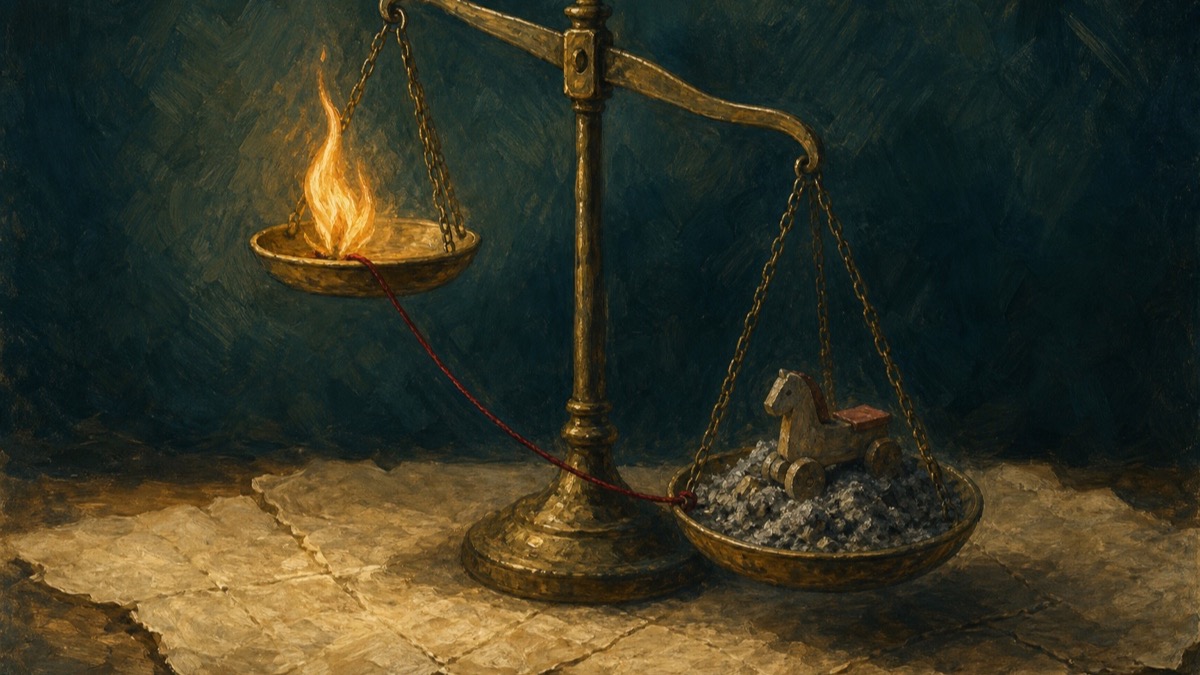
A hard magic system is one where the reader understands the rules well enough that the author can solve a problem with magic and it feels earned instead of cheap.
That is the whole definition. Everything else people say about hard magic, the tables of metals, the energy equations, the careful lists of what a spell can and cannot do, is downstream of that one requirement.
Sanderson put it as a law. Your ability to solve conflict with magic is directly proportional to how well the reader understands that magic. Hard is not "detailed for its own sake." Hard means the limits are known and enforced, so when the hero wins with magic it reads as a clever use of established rules and not a bailout.
What "hard" actually means
Most guides tell you a hard magic system has rules, is consistent, and avoids being overpowered. True, and useless, because it skips the reason those things matter.
The reason is trust. When a reader knows what magic costs and what it cannot do, they can watch a character reason inside those limits and get to a solution the reader could have half-predicted. That is the payoff. The hero is not saved by the author reaching in. The hero wins by using a rule the reader already learned.
Softness fails the opposite way. If nobody knows the rules and the wizard suddenly does the exact thing the plot needed, the reader feels handled. The rescue came from outside the story.
So hardness is not a spectrum of detail. It is a spectrum of reader knowledge. The more the reader understands, the more freely magic can carry the plot.
The hard/soft spectrum
Every magic system sits somewhere between two jobs. One job is to create wonder and problems. The other job is to solve problems in a way the reader accepts. You cannot do both well with the same magic, which is why the spectrum exists.
| Soft magic | Hard magic | |
|---|---|---|
| Reader knows the rules | No, or barely | Yes, in useful detail |
| Main job in the plot | Create problems, mystery, awe | Let characters solve problems |
| When magic wins the day | Feels cheap, avoid it | Feels earned, that is the point |
| Cost | Often vague or unstated | Specific and always paid |
| Best for | Mythic scale, dread, the numinous | Puzzle plots, tactics, systems |
Gandalf is the clean example of the left column. You never learn how his magic works, and you are not supposed to. He almost never solves the plot with a spell. When he does something big, it lands as awe, not as a solution you were tracking. That is correct for that job. A soft magic system trades problem-solving for mystery on purpose.
Neither column is better. They do different jobs. The mistake is wanting soft-magic wonder and hard-magic problem-solving out of the same system, then wondering why the ending feels both confusing and convenient.
Real systems and their exact rules
The useful part of studying published systems is not the flavor. It is the specific limit that makes each one enforceable on the page.
| System | Author / work | The rule that makes it hard |
|---|---|---|
| Allomancy | Brandon Sanderson, Mistborn | You swallow and burn specific metals. Each metal does one defined thing, iron pulls metal toward you, steel pushes it away, and you run out. Powers, costs, and limits are all published to the reader. |
| Sympathy | Patrick Rothfuss, The Kingkiller Chronicle | Magic obeys conservation of energy. To warm one thing you cool another, and a bad energy link wastes most of what you spend. It is basically thermodynamics with a caster attached. |
| Alchemy | Hiromu Arakawa, Fullmetal Alchemist | Equivalent exchange. To make something you give up something of equal value. The whole tragedy of the story is two brothers learning that the law does not bend for grief. |
| The Ancient Language | Christopher Paolini, The Inheritance Cycle | Words in the true tongue command what they name, but casting drains energy proportional to the task. Lifting a boulder costs what lifting a boulder costs, so a careless spell can kill the caster. |
Look at what those four share. In every case the reader can state the cost out loud. Burn the metal and it is gone. Warm this and something else goes cold. Make this and lose that. Move the boulder and pay the boulder's weight in your own strength. The limit is a sentence a reader can hold in their head, which is exactly what lets these authors solve fights and escapes with magic without it feeling like cheating.
I ran into the same thing building Mudwick, one of my own worlds. Its magic runs on residue, the traces that experiences leave in a place, and the cost is that when you draw on a place you take on its grief. That single limit constrains every use. You cannot casually solve a problem with residue magic, because solving it means carrying what the place carried. The rule does the work the plot needs.
How to build one
Three moves, in order. Most weak systems get the order wrong and start with powers.
1. Limits first
Decide what magic cannot do before you decide what it can. This feels backwards and it is the most important step.
Powers are easy to invent and impossible to bound after the fact. If you start with "she can control fire" you spend the rest of the book explaining why she does not just win. If you start with "fire magic cannot be used indoors and blinds the caster for a minute after," you have a character who has to think.
The limits are the hardness. A power with no boundary is not a hard magic system. It is a plot hole with good production values.
2. Give it a cost that is always paid
A limit says what magic cannot do. A cost says what it takes from you when it does work. You need both.
The cost has to be paid on the page, every time, including the times it is inconvenient for you. A cost the reader sees dodged once stops being a cost. This is also where the moral weight lives, because a system where magic always costs someone something is a system where using it is a choice with a victim or a price, not a free tool.
Fatigue is the laziest cost and the easiest to forget to enforce. Better costs are the ones that make the character weigh whether the win is worth it.
3. Keep it consistent, and keep the rules the reader needs separate from the ones you need
There is a difference between the rules of your magic and the limits the reader has to track. You can know a hundred things about how your system works. The reader only needs the handful that will decide a scene.
Consistency means those handful of rules never quietly change. If teleporting costs a memory in chapter three, it costs a memory in chapter thirty, even when that is expensive for your plot. The moment you make an exception without setting it up, you have taught the reader the rules are negotiable, and every future win with magic reads as maybe-the-author-cheated.
For the wider frame around all of this, from source to society, the general magic system creation process holds the limits and costs together with the rest of the world.
Where hard magic systems go wrong
The failure modes are specific, and they are not the ones the pitfall lists usually warn about.
Rules with no teeth. You state a limitation, then never show it enforced. A cost nobody pays and a rule nobody breaks are decoration. Someone has to hit the limit on the page, pay for it, and have it hurt, or the reader does not believe the limit exists.
Over-explaining. Hard does not mean you dump the appendix into chapter one. The reader needs the rules that will decide scenes, not a physics lecture. Sympathy works in Rothfuss because you learn the energy cost through Kvothe burning himself, not through a lecture hall, even though the lecture hall is right there.
Magic as a get-out-of-jail card. This is the big one and it is the reason the whole hard/soft distinction exists. If your hero escapes by doing something with magic the reader did not know was possible, the rules were soft when it counted, no matter how many tables you wrote. The test is simple. Could an attentive reader have seen the solution coming from the rules you gave them? If not, you did not solve the problem. You dismissed it.
Building the cost, then discounting it. You establish that resurrection costs a life, and then your protagonist resurrects someone and the story treats it as a win. Either the cost is real and the win is complicated, or the cost was never real. Pick one and mean it.
FAQ
What is the difference between a hard and soft magic system? A hard magic system is one the reader understands well enough that magic can solve problems and feel fair. A soft one keeps its rules hidden and uses magic mainly for wonder and to create problems. The line is not detail, it is how much the reader knows.
Can magic solve the plot in a hard magic system? Yes, and that is the point of making it hard. Because the reader knows the rules, a character solving the climax with magic reads as clever use of established limits rather than a rescue. In a soft system that same move feels like cheating.
Do I have to explain every rule to the reader? No. You only have to make clear the rules that will decide scenes. Over-explaining is a common failure. The reader needs the cost and the limits that matter for the story, learned through use, not a full technical manual.
Is hard magic better than soft magic? Neither is better. They do different jobs. Soft magic is built for mystery and awe and should mostly not solve problems. Hard magic is built to let characters solve problems inside known limits. Many strong books use both, keeping the numinous stuff soft and the tactical stuff hard.
What is the single most important part of a hard magic system? The limits, defined before the powers. What magic cannot do, and what it costs when it works, are what let the reader trust a magical solution. Get the limits right and consistency and payoff follow. Get them wrong and no amount of detail saves it.