
Obsidian Tavern
Obsidian Tavern

No. 01 — the offer

I’m not a bestseller. I make a couple grand a month from my fiction. Here’s exactly how.

Most people who want to write fiction for a living never make a dollar from it. Not because they can’t write. Because nobody ever handed them the whole path from blank page to a body of work people actually pay for.

This is that path. Five frameworks I’ve used to build 27 worlds, write 60-plus stories, and pull a couple thousand a month from words I own.

see what’s inside ↓

No AI writes your stories for you. That’s the point.


No. 02 — the stall

Here’s how it actually goes

You get an idea. A good one. A world with a rule nobody’s seen, a character you can almost hear talking.

You open a doc. You write three pages. Maybe thirty. And then it stalls, because you don’t actually know what happens next, or why anyone should care, or whether the magic you invented holds up if someone pokes at it.

So you research more. You build more world. You collect more notes. Notes feel like progress. They aren’t. A folder with two hundred pages of lore and zero finished stories isn’t a writing career. It’s a very organized way of not writing.

Then somebody online says they make real money from fiction, and something in you goes why not me — and something right behind it goes because you never finish anything.

That second voice isn’t telling the truth. It’s just telling you that you’ve never had a system. Different problem. Fixable problem.

A writer working by candlelight, absorbed and content, surrounded by hand-drawn maps and pages with a softly glowing seed-stone on the desk
One page at a time, by candlelight. The work is the whole thing.

No. 03 — the honest number

What “making a living” actually looks like

Let me be straight with you, because the rest of the internet won’t.

I’m not on a bestseller list. I don’t have an Amazon empire. I make a couple thousand dollars a month from fiction I built from nothing, and I did it by finishing things — over and over — using the exact frameworks in this bundle.

A couple grand a month doesn’t sound like a fantasy. That’s the point. It’s real, it’s repeatable, and it’s built one finished story at a time. Do that consistently and it grows. That’s not a promise of overnight money. It’s a promise of a method that actually produces work, which is the only thing that ever pays.

There are a handful of skills between you and that — world, story, book, magic, polish — and each one has been the thing that stops a writer cold. So I built a framework for each. Five of them. That’s the spine of the bundle, plus a reference course for the workspace it all runs in.


No. 04 — the frameworks

Five frameworks. One straight line from idea to income.

Five full frameworks. Over 80 lessons. Two complete worked stories you can open and read — one short, one book — built in front of you so you watch every move land instead of just reading about it. Here’s each piece, with the whole thing laid open under it if you want to see exactly what you’re getting.

A writer at an open book from which a whole glowing world rises — mountains, a river, and a distant golden city
World, story, book, magic, polish. The whole path off one page.
01

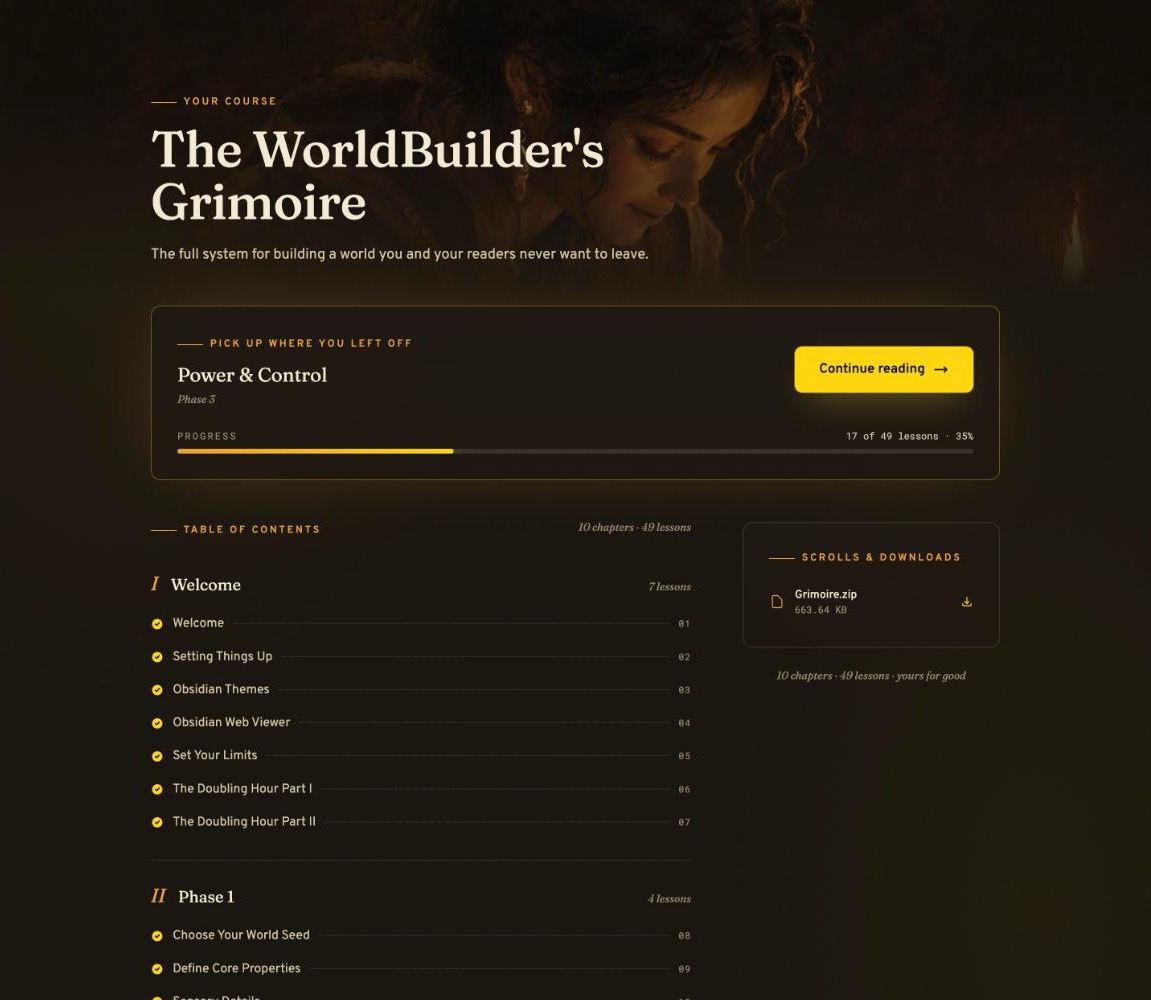
The Worldbuilder’s Grimoire

Fixes: “I have an idea but no world to set it in.”

Eight phases that grow one strange sentence into a living world — economics, power, belief, geography, history, all of it connected. You start with a single seed and end with a place deep enough to hold a hundred stories. This is where every world I’ve built started.

Open the full 8-phase framework →

Every phase has a worksheet, the steps that build it, and a challenge that forces the world out of your head and onto the page.

  • Phase 1 — Planting Your Seed. The one strange sentence everything else grows from.
  • Phase 2 — Growing the First Roots. Economics and value, daily life, social ripples. Challenge: A Day in the Life.
  • Phase 3 — Developing Core Systems. Power and control, belief and meaning, knowledge and expertise. Challenge: The Expert and the Novice.
  • Phase 4 — Creating Complexity through Conflict. Natural tensions, opposing viewpoints, adaptation. Challenge: The Dispute.
  • Phase 5 — Expanding Your Geography. Physical distribution, cultural variation, travel and trade. Challenge: The Map and Key.
  • Phase 6 — Deepening the History. Origin story, evolution over time. Challenge: The Historical Document.
  • Phase 7 — Building Connected Systems. How every system you built touches every other one. Challenge: The System Map.
  • Phase 8 — Bringing It All Together. A living society, current challenges, individual perspectives. Challenge: the world in motion.

Plus Special Applications (deep-dive frameworks for political systems, economics, and magic) and a Resources & Tools kit — reading list, every template in one place, common problems and fixes, and how to use AI as a worldbuilding partner without letting it write for you.

02

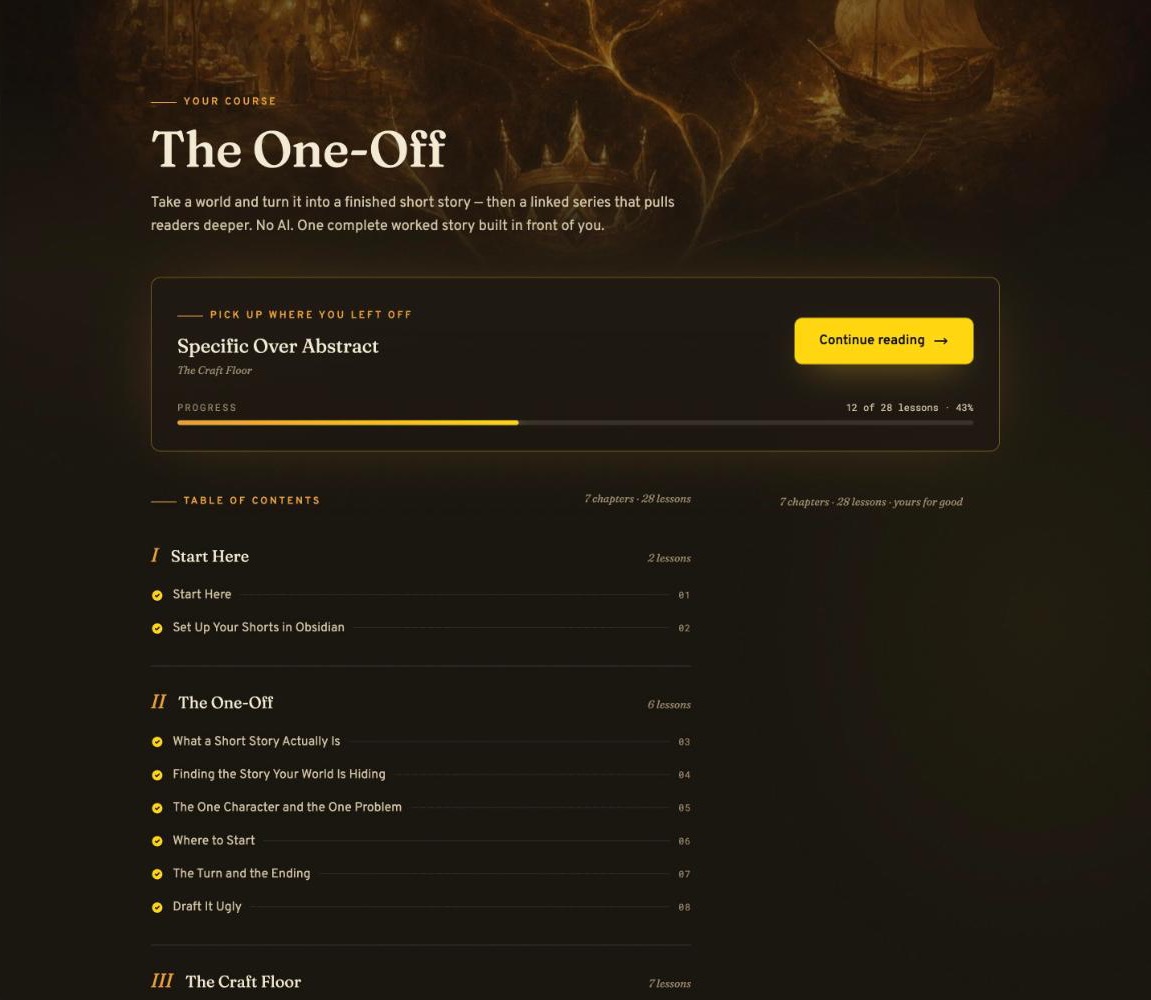
The One-Off

Fixes: “I have a world but I can’t turn it into a story.”

A world is raw material. A story is one person in that world on the worst or strangest hour of their life. This course takes you from world to a finished short — then to a plan for a dozen more that quietly talk to each other and pull readers deeper. No AI. Nothing writes it for you. Just the moves, and one full story built in front of you start to finish so you watch the ugly become clean with nothing hidden.

Open all 5 sections, 30 lessons →
  • Section 1 — The One-Off (6 lessons). Finish one short, start to finish. What a short story actually is, finding the story your world is hiding, the one character and the one problem, where to start, the turn and the ending, and drafting it ugly. You can’t fix a story that doesn’t exist yet.
  • Section 2 — The Craft Floor (7 lessons). Now make it good. Ground everything in the body, specific over abstract, entering rooms through one detail, sentence rhythm, cutting the explaining, dialogue and similes, and the rules of the page. This is the floor everything else stands on.
  • Section 3 — The Series (5 lessons). Your first short was never alone. Standalone shorts that secretly link, the buried thing, reveal order vs world-time order, the quiet cross-reference web, and what each short adds. You stop writing stories and start building a shelf.
  • Section 4 — The Edit (4 lessons). Catch the miss after the fact. Draft ugly then see clean, the failure modes (the tourist, the robot, the stacker, the cataloger), the after-you-write scan, and killing your darlings.
  • Section 5 — Getting It Out (3 lessons). The spoiler-free teaser that earns the click, formatting for the phone, and why first person gets read as true.

Plus an Obsidian setup lesson and a complete worked short story, “The Number,” built across the course.

03

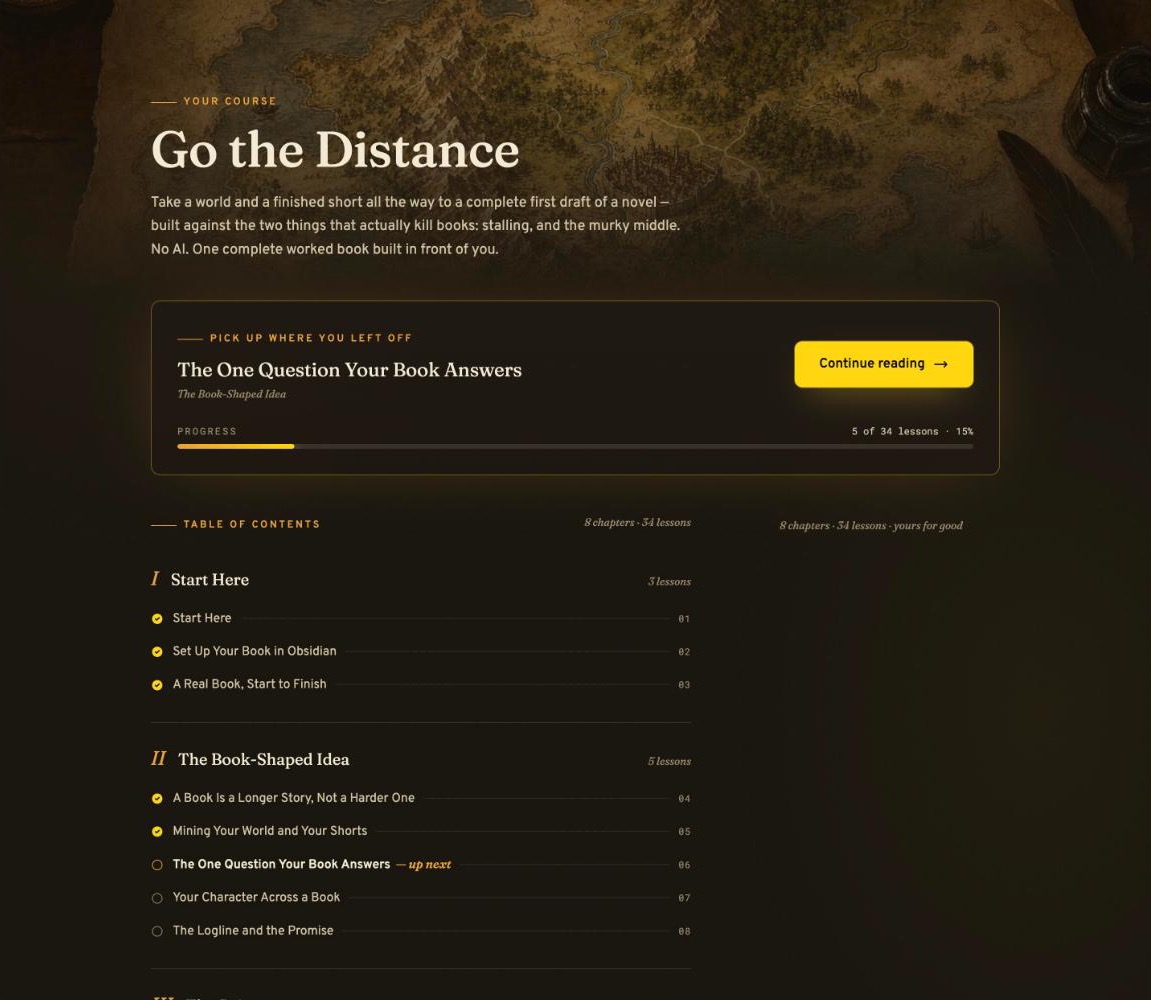
Go the Distance

Fixes: “I can finish a short but a book feels impossible.”

A book isn’t a harder story. It’s a longer one. Everything you learned writing shorts still holds — it just has to survive months instead of an afternoon. This course takes you from a world and a finished short to a complete first draft of a novel, and it’s built against the two things that actually kill books: not knowing what happens next, so you stall, and the murky middle, where you become sure the whole thing is garbage and want to quit. No AI. Nothing writes it for you. Just the architecture that keeps you moving and the honest talk that gets you across the part where everyone else stops.

Open all 6 sections, 28 lessons →
  • Section 1 — The Book-Shaped Idea (5 lessons). Most ideas can’t survive being a book. Find one that can. Why a book is a longer story not a harder one, mining your world and your shorts, the one question your book answers, your character across a whole book, and the logline and the promise.
  • Section 2 — The Spine (5 lessons). Just enough outline that you never stall, without disappearing into notes forever. Act math, the turns that hold it up, scene blueprints without overbuilding, and one map you can hold in your head.
  • Section 3 — The Drafting Engine (7 lessons). Where the book actually gets written. Wire up a witness, draft it ugly at book scale, the session not the book, momentum over mood, what to do when the plan and the draft disagree, tracking without stalling, and how to come back after you’ve already stopped.
  • Section 4 — Crossing the Middle (5 lessons). The exact spot books die. The book isn’t bad, you’re in the middle. The sagging middle as a craft problem, the voice that says quit, why restarting is how books die, and the halfway recommit. This section is placed precisely where you’ll need it.
  • Section 5 — Landing It (4 lessons). The downhill half, paying off the promise you made in Section 1, writing the ending ugly too, and understanding that done means whole, not good.
  • Section 6 — The Handoff (4 lessons). What you actually have, why it goes in the drawer, the handoff to EditForge, and why the next book is easier.

Plus an Obsidian setup lesson, a “real book start to finish” walkthrough, and a complete worked book, “The Ledger of Small Debts,” built across the whole course.

04

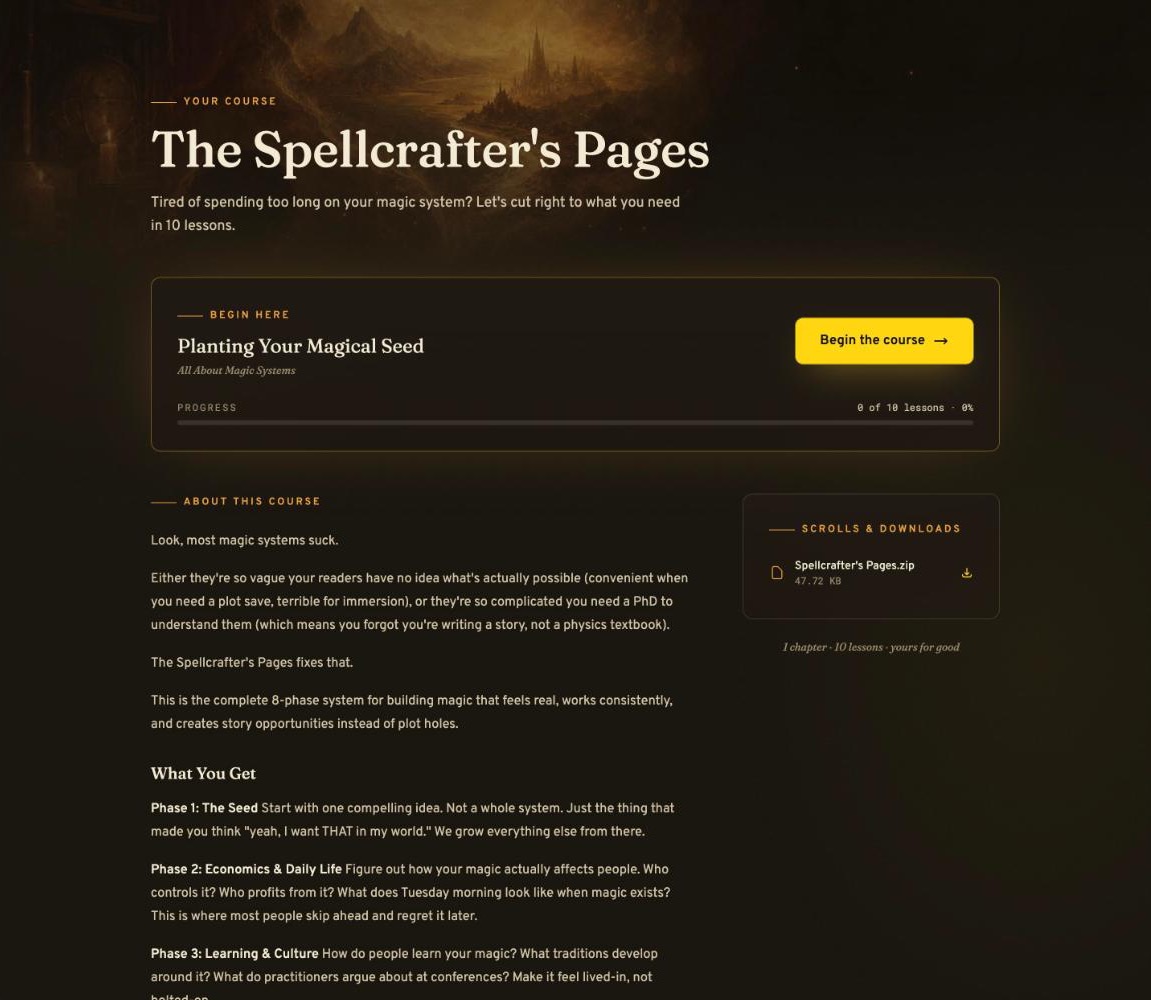
Spellcrafter’s Pages

Fixes: “My magic falls apart when anyone looks closely.”

The reason so much fantasy feels weightless is that the magic has no cost, no rules, no consequences. This is an 8-phase system for building a magic system that holds up — with stress tests that try to break it before your reader does. Bolt this onto any world and the whole thing suddenly feels real.

Open the full 8-phase magic framework →

Same eight-phase spine as the Grimoire, aimed entirely at magic:

  • Phase 1 — Planting Your Magical Seed
  • Phase 2 — Growing the First Roots
  • Phase 3 — Developing Core Systems
  • Phase 4 — Creating Complexity through Conflict
  • Phase 5 — Expanding Your Magical Geography
  • Phase 6 — Deepening the Magical History
  • Phase 7 — Building Connected Systems
  • Phase 8 — Bringing Magic to Life

Plus a full Worksheets & Templates pack, Advanced Troubleshooting Prompts for when a system won’t cohere, and a Magical Stress Tests appendix that tries to break your magic before a reader does.

05

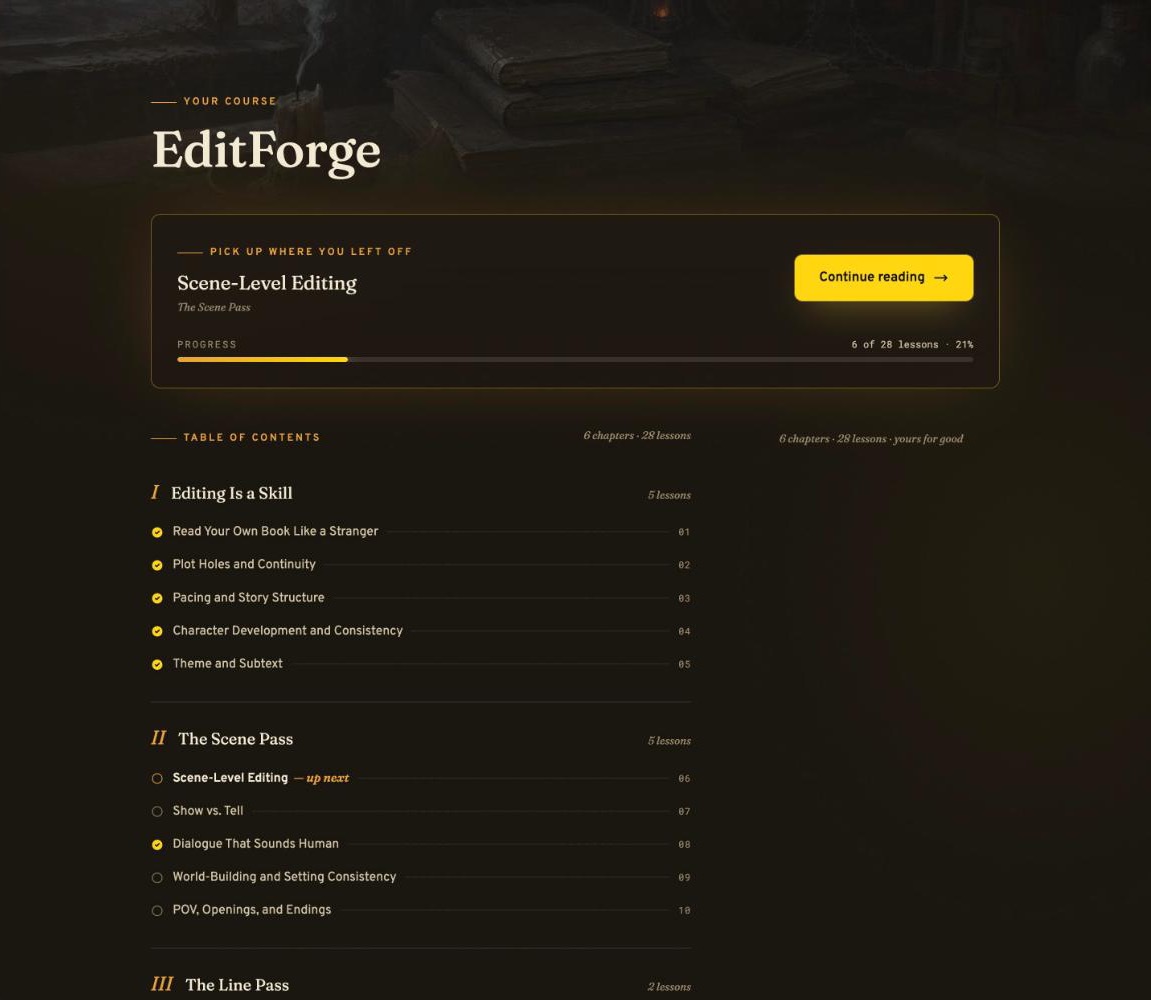
EditForge

Fixes: “My draft is done but it’s not good yet.”

Every first draft is ugly. That’s not a flaw, it’s the job. EditForge is the 21-chapter system for turning an ugly draft into something clean — the failure modes to hunt for, the scan to run after you write, and how to kill the darlings that are quietly wrecking your story. Finishing is a skill. This is the skill.

Open all 21 chapters plus appendices →

21 chapters taking a draft from its first honest read to final polish — the failure modes to hunt, the after-you-write scan, structural fixes, line-level cleanup, and killing the darlings that are quietly wrecking the story. Backed by five appendices (A–E): reference checklists and tools you’ll reach for on every draft after this one.

Bought separately, these are five full frameworks. Together they’re the whole path — world, story, book, magic, polish — with no gap where writers usually quit. That’s the part nobody sells you: the sequence.


No. 04a — the reference course

Plus the reference course that ties it all together

+

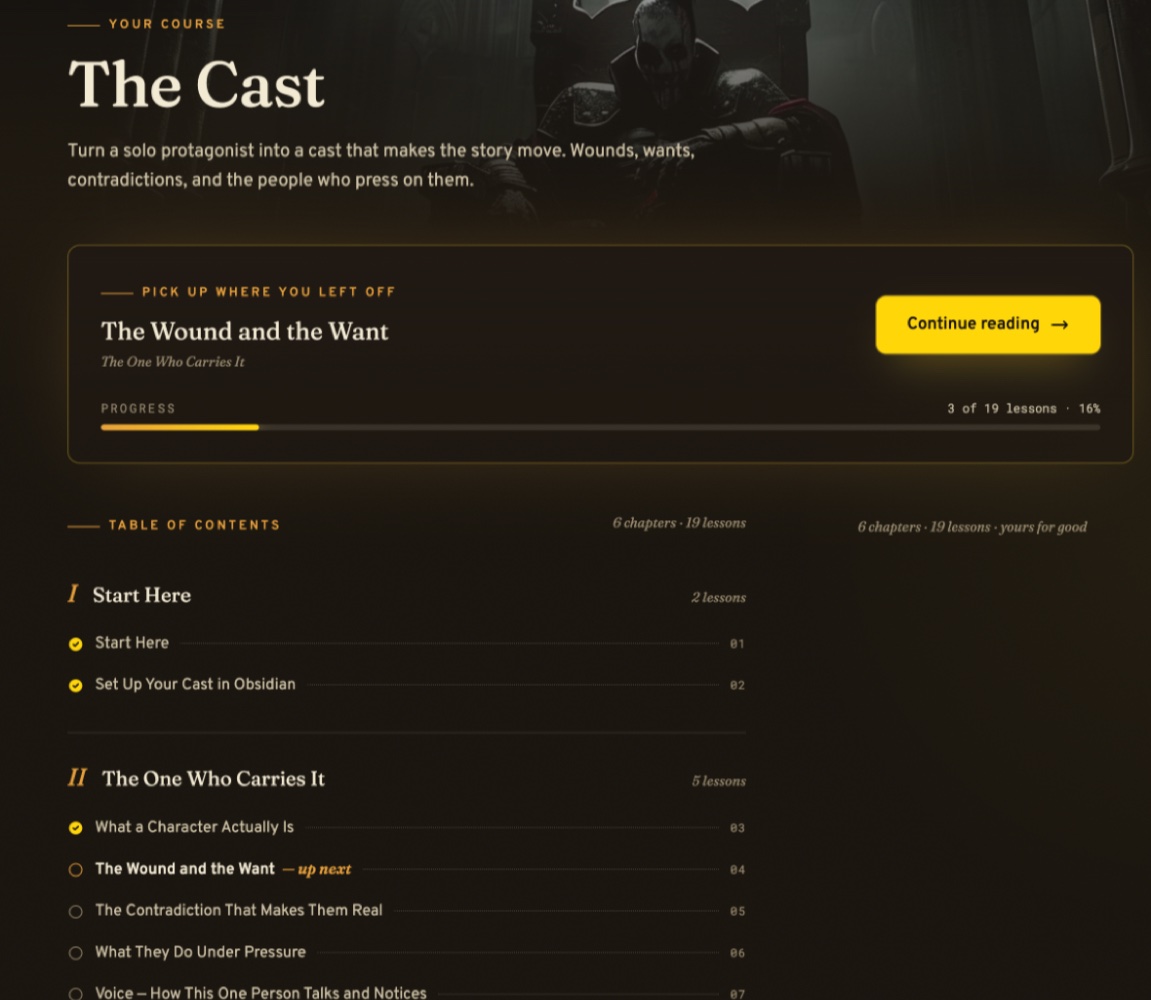
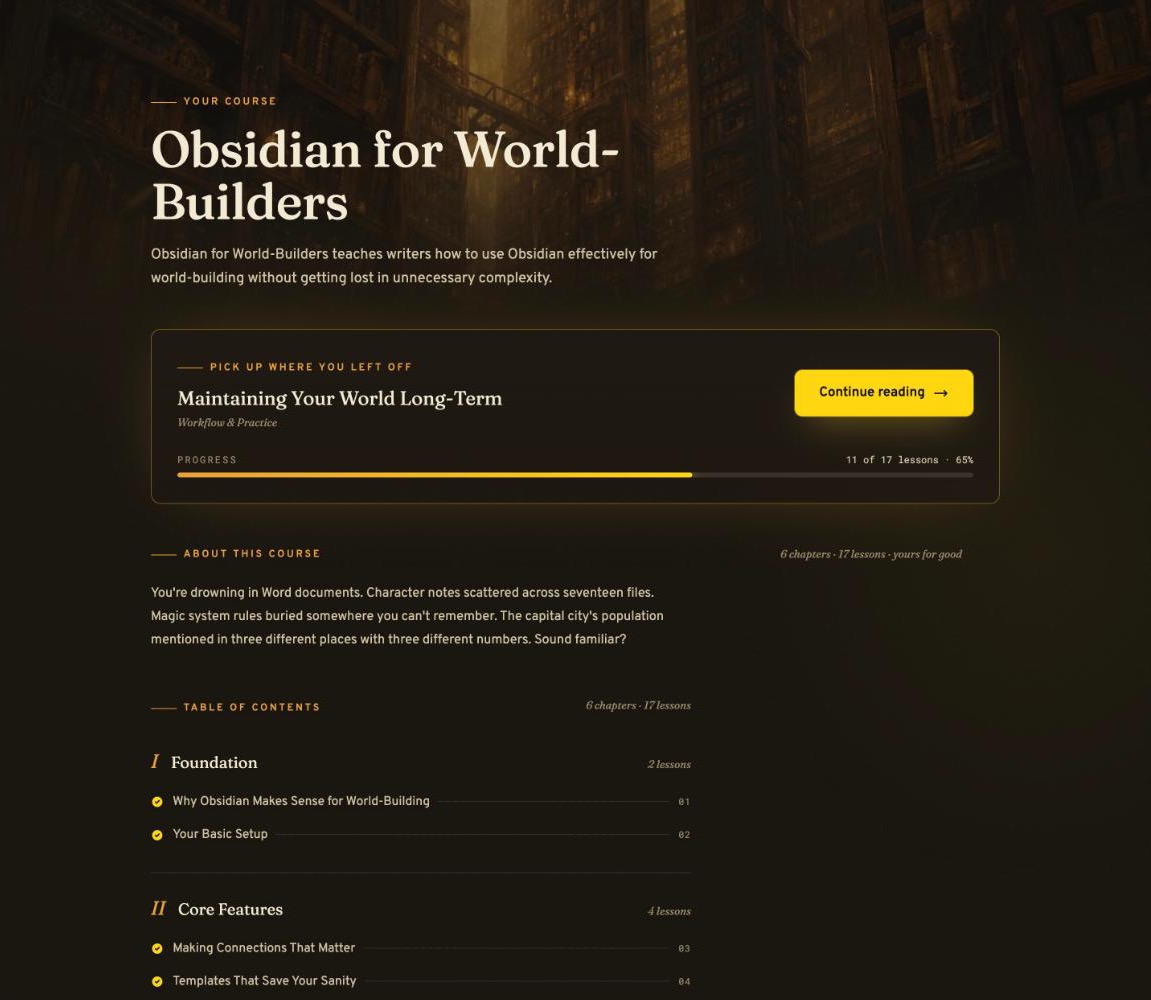
Obsidian for World-Builders

Here’s what nobody warns you about: a world outgrows a folder of Word docs fast. Character notes in seventeen files. The capital’s population written three different ways in three different places. A magic rule buried somewhere you can’t remember.

Every course above is built to live in one calm, connected Obsidian vault instead of that mess. You don’t have to learn Obsidian before you build a world — go start the Grimoire the second you buy, that’s where the momentum is. This course sits beside the path as the reference you reach for when you want it. Stuck on templates? Open lesson 2.2. Want your world to link itself together? Section 2. Ready to make the vault genuinely nice to work in? Section 5.

No prior experience assumed. Dip in when you need it, ignore it when you don’t. It’s just always there.

Open all 6 sections, 19 lessons →
  • Section 1 — Foundation (2 lessons). Why Obsidian makes sense for world-building, and your basic setup. Start from zero.
  • Section 2 — Core Features (4 lessons). Making connections that matter, templates that save your sanity, tags without the chaos, and properties — your secret weapon.
  • Section 3 — Enhancement Tools (4 lessons). Canvas for visualizing your world, search and navigation that actually works, daily notes for world-building, and the plugins worth your time.
  • Section 4 — Workflow & Practice (3 lessons). Building your world session by session, maintaining it long-term, and working across devices.
  • Section 5 — Advanced Techniques (3 lessons). Dataview for world-builders, making your vault pretty, and exporting your world.
  • Section 6 — Appendices. A sample vault structure you can copy and start from.

Ships with a Start Here walkthrough and a ready-to-use vault layout so you’re not staring at a blank screen.


No. 05 — is this you?

Let’s make sure this is for you

This is for you if

  • You want to write fiction and you’re sick of starting things you never finish
  • You’ve got worlds and ideas but nothing a reader could actually hold
  • You want a real, repeatable system more than you want a pep talk
  • You’re okay with the work. Because there’s work.

This is not for you if

  • × You want AI to write your stories. Wrong bundle. Genuinely.
  • × You’re looking for a get-rich guarantee. I make a couple grand a month, not a killing, and I won’t pretend otherwise.
  • × You already finish and sell fiction consistently. You don’t need this.

No. 06 — the offer

A hand-painted fantasy world map on aged parchment with mountains, coastlines, a walled city, a compass rose and a legend, a quill and inkwell resting at its edge
The kind of world this whole bundle is built to produce.

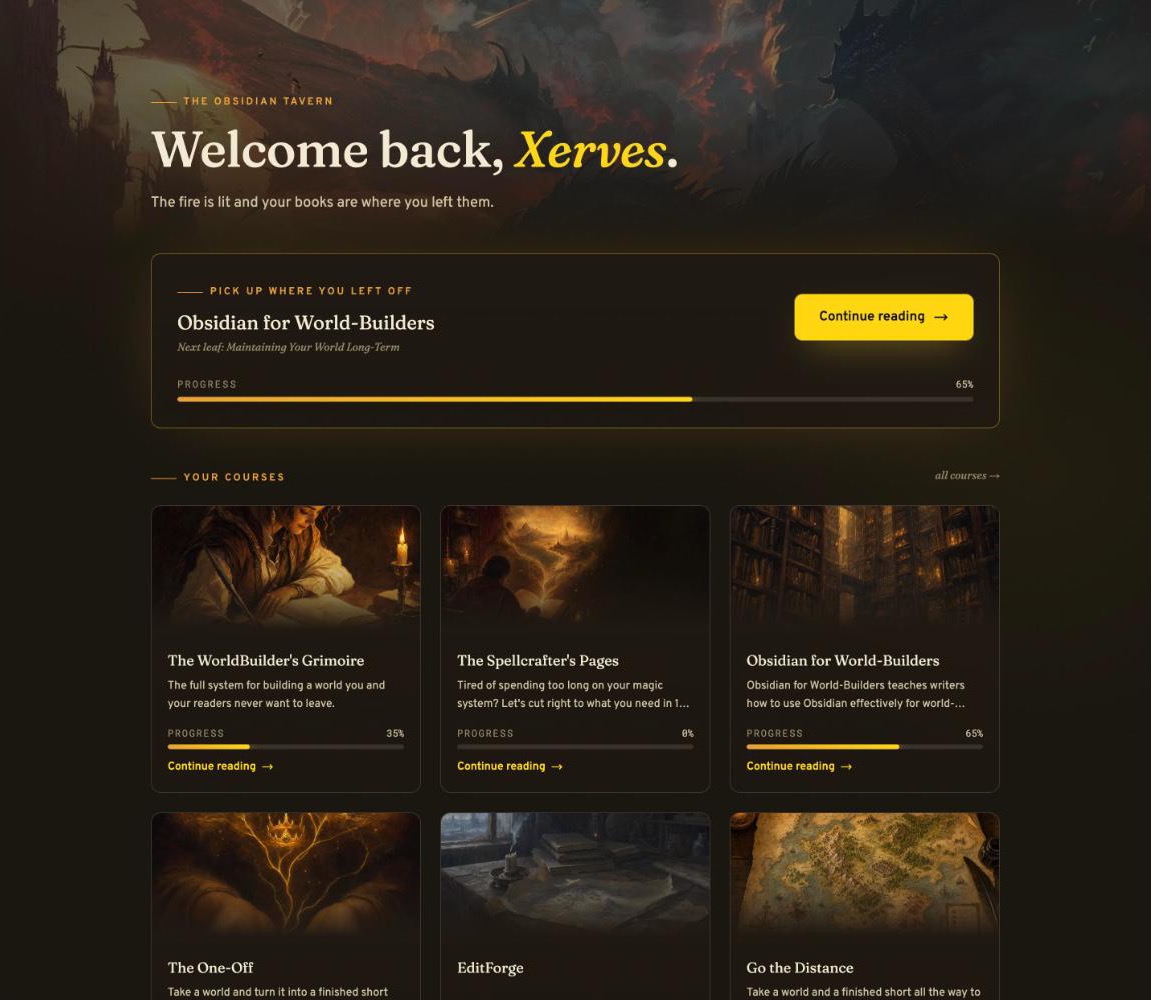
bought one at a time

  • The WorldBuilder's Grimoire $199
  • The One-Off $99
  • Go the Distance $149
  • The Spellcrafter's Pages $49
  • EditForge $99
  • Obsidian for World-Builders $49
  • Total if bought separately $644
Yours today, pre-order $99 save $545 · 85% off

the whole weight, in one place

  • The Worldbuilder’s Grimoire — 8 phases, worksheets and challenges throughout, Special Applications, and a full resources kit
  • The One-Off — 5 sections, 30 lessons, plus a complete worked short story
  • Go the Distance — 6 sections, 28 lessons, plus a complete worked book
  • Spellcrafter’s Pages — 8 phases, worksheets and templates, troubleshooting prompts, and a stress-test appendix
  • EditForge — 21 chapters and 5 appendices
  • Obsidian for World-Builders — the reference course: 6 sections, 19 lessons, plus a copy-and-go vault structure

Over 80 lessons. Five frameworks plus the reference course. Two finished stories built in front of you. Every worksheet and template. Lifetime access.

The whole thing, before the price goes up

Five frameworks and the reference course that holds them. The complete path from a blank page to a body of work you own and can sell.

You’re getting it for half because you’re getting it early. When the bundle launches it’s $299 and it stays there.

pre-order — half price

d h m left

$99 $299

Lifetime access. Yours to keep, work through at your pace, and come back to on the next world.


No. 07 — the truth about finishing

A single golden sprout breaking from a glowing seed, roots spreading into dark soil toward warm light
One finished thing, then the next. That’s how it grows.

The writers who make it aren’t the most talented

They’re the ones who finished. Again and again, until finishing stopped being remarkable and started being Tuesday.

You don’t need permission and you don’t need more talent. You need the path, and you need to walk it. I built the path. The walking’s on you — but at least now you know where it goes.

$99 now. $299 at launch. No AI, no hype, no bestseller fairy tales. Just the system I actually use.

d h m s
Pre-order has closed