Almost every guide to building a fantasy world starts you on a map.
Draw a coastline. Add a mountain range in the north, a desert in the south, a forest somewhere convenient. Name three kingdoms and pick a climate for each.
Then you sit there with a beautiful piece of paper and no story, because none of it is load-bearing.
A map is a record of decisions. It cannot be the first decision.
What makes a world feel real is not the number of things in it. It is that everything in it appears to have been caused by something else. Readers cannot articulate that, but they can feel the difference between a world that was assembled and a world that grew.
So the build order matters more than the checklist. You start with one rule, and you let the world be the consequence of it.
Start With One Changed Rule
Pick one thing that is true in your world and not true in ours.
Not five things. One.
Magic exists is too vague to be useful, because it does not tell you anything about how anyone lives. You want a rule specific enough to be violated.
Dead people can be questioned, but only for nine days, and only by their next of kin. Weather can be bought. Every debt is physically visible on the debtor's skin.
Each of those is a small change, and each one detonates.
The nine-day rule alone gives you funeral customs, inheritance law, a class of professional mourners who are really investigators, a nine-day window where murderers cannot leave town, and a black market in false next of kin. None of that came from a map. It came from being specific about one rule and refusing to look away from it.
The reason this works is that it forces you to build from cause instead of taste. When you start with geography, you are picking things you like. When you start with a rule, you are answering questions you did not choose, and the answers surprise you.
Write your rule as a single sentence. If it takes a paragraph, it is not one rule yet, it is three, and you should pick the most interesting one.
Follow the Consequences Past the Obvious Ones
This is the step almost everyone skips, and it is the entire job.
First-order consequences are easy. Magic heals wounds, so people get healed. Anyone can do that in an afternoon.
First-order thinking is what gives you a world where wizards exist and everything else looks like generic medieval Europe with better lighting.
The interesting stuff starts two steps out and keeps going as long as you keep asking.
Magic heals wounds is first order. Second order, war becomes survivable and armies get bigger, because you can put the same soldier back in the line four times. Third order, the value of a trained soldier goes up and the value of a peasant conscript goes down, so warfare gets professional, expensive, and controlled by whoever can afford healers.
Fourth order, healers are strategic assets, so they are not free people anymore. They are drafted, licensed, guarded, or owned. Now you have a plot, and you never wrote a single word about a fireball.
The discipline is simple to describe and hard to do. Take your rule, ask what changes, then ask what changes because of that, then ask it again. Stop when you hit something ugly, because ugly is where stories live.
You will notice that a few questions in you are no longer writing about magic. You are writing about labor, property and access, and every rule in a world eventually becomes a question about who gets to use it.
A hard magic system makes this easier to track, because defined limits give you defined consequences, but even a mysterious system has to obey its own economics.
Ask Who Benefits and Who Pays
Every system in a world has a winner and a loser. If you cannot name both, you have not finished building it.
This is the fastest way I know to turn a static setting into a plot. Take your rule, find the people it makes rich, then find the people it grinds down, then notice that both groups know exactly what is happening and are stuck in it anyway.
That mutual awareness is the part worth writing. Nobody in the arrangement is fooled, and they stay in it because leaving costs more than staying.
In Mudwick, the rule is that experiences leave residue in places and that residue is power. I did not sit down to design an oppressive society. I just followed the rule honestly, and if power accumulates in locations, then whoever owns the locations owns the power, which means thirteen families with old land end up controlling access and quietly draining the junior practitioners who need it.
It organized itself along the same lines as every other resource economy, because why would magic be different. That was not a creative decision. It was arithmetic.
Do the same to your rule. Who inherits the advantage instead of earning it, and who is told they are lucky to be allowed near it. The answer to the second question is usually your protagonist.
Let Scarcity Build the Culture
What is rare in your world decides what people fight over, and what people fight over decides who they are.
Culture is not a costume. It is a set of habits that formed around a shortage. Our own funeral rites, marriage laws, food taboos and inheritance customs are mostly negotiated settlements about scarce things, and they look arbitrary only from outside.
So do not ask what your culture's traditions are. Ask what they do not have enough of.
A world where fresh water is scarce and magic can conjure it produces a religion built around the people who conjure, a legal system obsessed with water rights, and an insult vocabulary about waste. A world where memory is the scarce resource has libraries with armed guards and a class of people who rent out their recall.
Once you know the shortage, the traditions write themselves and they stop feeling like decoration.
This is also where language starts to matter, because a culture invents precise words for the thing it cannot afford to be vague about. If you want to build that out properly, worldbuilding languages covers how vocabulary follows need. The rest of it, class structure and law and who gets to hold office, is what worldbuilding societies is for.
Don't get me wrong, some cultural detail is just flavor and that is fine. A midwinter festival where everyone wears their grandmother's coat is a nice image and it does not have to mean anything about grain supply. But the load-bearing parts should trace back to something the world does not have enough of.
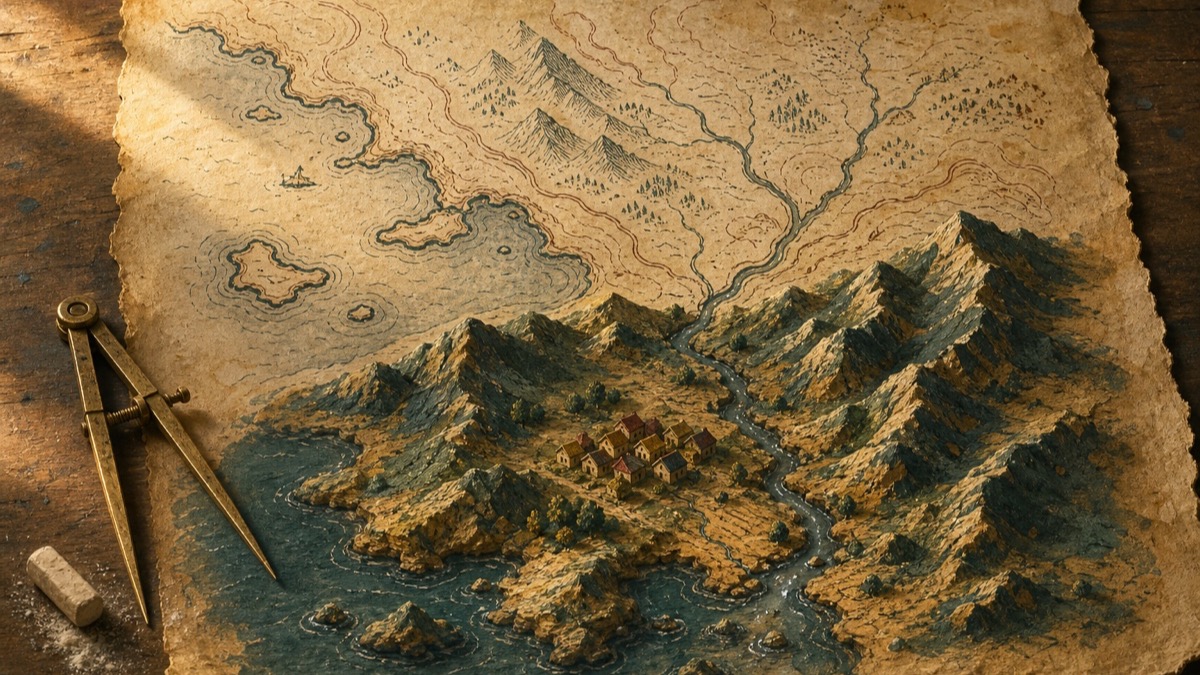
Now Draw the Map
Geography comes late, and when it comes, it is answering questions instead of asking them.
By this point you know what is scarce, who controls it, and who is locked out. The map's job is to make that physically true. Where is the resource, what stands between people and it, and what does the distance cost.
That is a map with meaning in it. A river is not there because rivers look nice. It is there because it is the only way grain reaches the capital, which means the bridge is worth a war.
I ran into this hard while building Odd Wonderful, a shattered archipelago where every island runs on its own impossible rules. One runs on song, one on debt, one on the unnamed. The geography did not come first and then get rules assigned to it.
It went the other way. The islands are separate because living bridges once connected them and were deliberately broken, and once you break the connections, the cultures and the magic drift apart into mutual myth. Each island becomes a rumor to the others.
The archipelago shape was the consequence, not the premise. And the interesting question stopped being what the map looks like and became who benefits from keeping the bridges broken, because somebody always does.
Test your own map the same way. If you moved a kingdom two hundred miles, would anything about the story break? If not, the geography is not doing work yet, and you should go back to the rule and ask what it demands physically.
Here is the order I would build in, and roughly how much time each stage deserves.
| Stage | What you are deciding | Time to spend |
|---|---|---|
| 1. The rule | The one thing true here and not in our world | An afternoon |
| 2. Consequences | What breaks, and what breaks because of that | Longer than you want |
| 3. Winners and losers | Who inherits the advantage, who pays for it | A day, and it gives you your plot |
| 4. Scarcity and culture | What is rare, what customs grew around it | A day |
| 5. Institutions | Who enforces the rule, who polices the exceptions | A day |
| 6. Geography | Where all of that physically sits | Half a day |
| 7. History | How it got this bad | As needed, in service of the present |
The stages that guides usually put first are the ones near the bottom. That inversion is the whole argument here.
Decide Which Details Survive the Trip to the Page
You will build far more than you use, and that is not waste, it is the point. Confidence on the page comes from knowledge off the page.
The useful question is which details earn passage. A detail survives if some person in a scene has to act differently because of it.
Your inheritance law never reaches the reader as law. It reaches them as a character hesitating before signing something, and the hesitation is only convincing because you know exactly what that document does to her.
So sort your notes by that test. The nine-day questioning window survives, because a widow has to decide whether to use it before it closes. The founding date of the mourners' guild does not survive, because nobody in the story has to do anything about it.
Roughly a tenth of what you build will pass that test, and the other nine tenths are still doing their job by keeping you from guessing. How to write high fantasy covers the craft of getting that tenth onto the page without stalling the story, which is its own problem and a bigger one when the world is enormous. Building a haunting world is the version where atmosphere carries the weight and almost nothing gets stated outright.
Know When to Stop Building
Worldbuilding is more comfortable than writing, which is why so many people never leave it.
Building has no failure state. Every hour produces something and nothing gets rejected. Drafting produces bad pages you have to fix, so the brain finds one more map to draw, one more calendar to invent, one more language to conjugate.
You are done when you can answer three questions about your protagonist's daily life without inventing anything new.
What does she eat and where did it come from. Who could ruin her and how. What does she believe that the world is about to prove wrong.
If those three come out fast and specific, you have enough. Start writing. The rest of the world will get built during the draft, and it will be better built, because the story will be asking for it instead of you guessing.
The world's real job is not to be complete. It is to put pressure on a person until they do something they cannot take back.
FAQ
How long should it take to build a fantasy world before I start writing? Days, not years. A focused week on the rule, its consequences, the winners and losers, and the resulting institutions will give you more usable material than six months of maps and calendars.
The rest gets built while you draft. If you have been worldbuilding for over a month and have no pages, you are not preparing, you are hiding.
Should I build the world first or write the story first? Build the pressure first, then write, then build the rest as the story demands it. You need one rule, its ugliest consequences, and a protagonist who is on the losing end of them. That is enough to start a draft.
Writing first with no rule tends to produce a story you have to retrofit a world onto, and the seams show. Building first with no story tends to produce an encyclopedia.
How much detail is enough? Enough that you never contradict yourself and never hesitate on a concrete question. If a character walks into a market, you should know what money looks like, who is allowed to sell, and what is expensive because it is scarce.
You do not need a full monetary history. You need to know what one loaf costs and why anyone would care.
Do I need a map at all? Only if distance matters to the plot. If travel time, chokepoints, or who controls the road ever affect an outcome, sketch enough to keep yourself honest.
If the story is confined to one city or one household, a map is procrastination with a nice aesthetic. Draw it after the draft if you want it for the book.
How do I make my world feel different from generic fantasy? Change one structural rule instead of changing the surface. Renaming elves to something with more apostrophes does nothing, because the underlying society is identical.
Change how death works, or how debt works, or how memory works, then follow it until the institutions look strange. Strangeness comes from consequence, not from vocabulary.
How do I know when the world is finished? It is not going to be, and that is fine. Treat it as finished when you can run three ordinary scenes with no research pauses and the world still generates obstacles on its own.
At that point the remaining gaps are the ones the story will fill better than you can in advance.